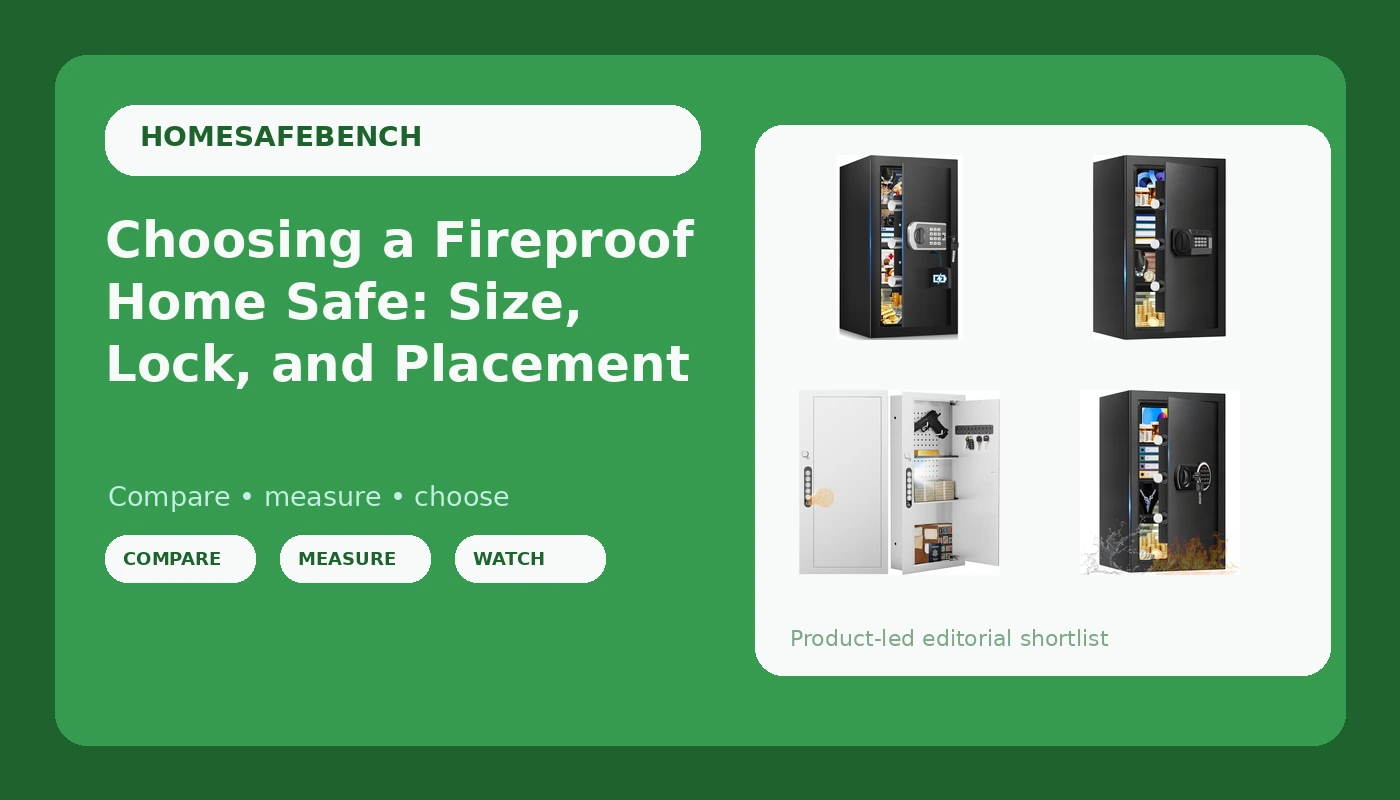
A fireproof home safe is two decisions wearing one coat. The first is storage: how much you need to put inside, and whether it should sit on a floor, bolt to a wall, or disappear between two studs. The second is resistance: what the door, the lock, and the fire rating will actually do when someone leans on them with a tool. Most shoppers settle the first question and guess at the second, which is how a large safe ends up unbolted in a closet and how a wall safe gets ordered for a wall that turns out to be framed in metal. The four options below cover the common shapes of that problem. The sections after them cover what to verify before you buy: the fire rating documentation, the door gap, the lock type, and the anchor.
Related: How to Bolt a Home Safe to a Concrete Floor →
Quick answer
Match the safe to the threat you actually face, then to the space you actually have. For a household storing documents, jewelry, and cash with floor space to spare, a 5.1 cubic foot digital safe offers the most interior capacity in this group and enough mass to anchor properly. If you want the documents themselves in a bag you can grab and carry, the 4.6 cubic foot model ships with a fireproof and waterproof bag. If concealment matters more than volume, a between-the-studs wall safe hides behind drywall and pairs a biometric reader with a backlit keypad. None of these is burglar-proof, and a fire or water claim means little until you have seen the rating documentation behind it.
Four useful options
| Model | Best fit | What stands out |
|---|---|---|
| 5.1 Cuft Large Safes for Home Use Fire and Water proof, Digital Keypad Safe with Key Lock, Anti-Pry Home Office Security Safe for Cash, Jewelry, Document, 3 Removable Shelves, 23.62"H x14.96"W x12.2"D | Households that need maximum interior volume on the floor | 5.1 cubic feet, three removable shelves, digital keypad with key lock, anti-pry door construction per the listing |
| 5.1 Cuft Large Home Safes Water and Fireproof with Digital Keypad & Key Lock, Fire Security Safes with 3 Removable Shelves, Anti-Pry Safe Box for Money Documents Jewelry, 23.62"H x14.96"W x 12.2"D | The same job, as an alternate listing to compare against | Same 5.1 cubic foot capacity and 23.62 x 14.96 x 12.2 inch footprint, three removable shelves, keypad and key lock |
| 23.6" Tall Large Home Safe, 4.6 Cuft Safe Box with Fireproof Waterproof Bag | Buyers who want a carry-out document bag included | 4.6 cubic feet at 23.6 inches tall, includes a fireproof and waterproof bag |
| 31.49‘’ Wall Safe Between the Studs, Biometric Hidden Safe with Removable Pegboard, In Wall Safe with Removable Shelf and Backlit Keypad (Fingerprint-White) | Rooms where a visible safe is a problem | Mounts between wall studs, biometric fingerprint entry, backlit keypad, removable shelf and pegboard |
The full-size floor safe
Two things matter more here than the cubic footage. First, a cabinet this size is a floor safe, and floor safes earn their keep when they are anchored. A unit of this size filled with paper and metal is heavy, but weight alone is not a strategy against someone with a hand truck. Bolts into a slab or through the floor into joists change the equation. Second, the keypad is the convenience layer and the key lock is the honest backup. Keypads fail, batteries die, and the override key is the part people lose. Decide where that key lives before the safe arrives, and make sure it is not inside the safe.
The second 5.1 cubic foot option
These two safes are near twins on paper, and that is worth saying plainly rather than pretending otherwise. When two listings describe the same capacity, the same footprint, the same shelf count, and the same entry methods, the deciding factors are the ones the spec sheet does not settle: the hardware in the box, the anchoring holes, the quality of the door fit, and the current listing details. Compare the two side by side, read the most recent buyer feedback for both, and check whether the mounting hardware is included. If you cannot tell them apart after that, buy the one whose listing is clearer about what ships in the box.
The 4.6 cubic foot model with a document bag
Understand what the bag is and what it is not. A fireproof bag is a flexible pouch, usually layered with a fire-resistant material, and it is not a safe. It does not resist a pry bar, and it does not anchor to anything. What it does well is hold papers together in a form you can grab on the way out the door, which is a real scenario and a common one. Used inside the safe, it adds a layer around the documents themselves. Ask the same question you would ask about the safe: what rating backs the claim, and at what temperature and duration. A half cubic foot less capacity is the trade you make for the smaller cabinet and the included bag.
The between-the-studs wall safe
A wall safe solves a different problem. It is not built for a box of files. It is built for the jewelry, the passport, the backup drive, and the cash you do not want sitting in a bedroom drawer. Concealment is the security feature: a safe nobody knows about does not get attacked. That advantage comes with two costs. Installation means cutting drywall and confirming stud spacing, typically 16 inches on center but not always, and it means the safe is only as strong as the framing it is screwed into. Biometric readers are fast when your finger is clean and dry and less forgiving when it is not, and the reader runs on batteries. Keep the keypad code and the mechanical override in the plan.
Prices and availability may change. Product images, names, and retailer links are matched to verified listings. No current price, rating, stock status, or measured result is stated here without current evidence.
What a fire and water claim actually means
A fire rating is a measurement, not an adjective. Real ratings are written as a time at a temperature, plus a maximum interior temperature the safe promises not to exceed during that window. Paper begins to char at roughly 400 degrees Fahrenheit, which is why document safes are built around keeping the inside cool while the outside burns. Digital media, photographs, and drives are far less tolerant and need much lower interior temperatures, so a safe that protects paper documents may not protect a hard drive. When a listing says fireproof, look for the rating language and the testing standard behind it. If neither is available, treat the claim as marketing until proven otherwise.
Water resistance works differently. A sealed door with a gasket can keep water out during a flood or a burst pipe, but that same seal traps humidity inside. Safes that live in basements or garages need a desiccant pack, and they need the door opened periodically so the interior can breathe. Waterproof claims should be read the same way as fire claims: what depth, what duration, what standard. A safe that keeps documents dry in an inch of standing water is doing something useful. That is not the same as surviving a submerged basement for a week.
How the lock and the door gap decide the outcome
The lock is the safe. A digital keypad is the honest middle ground: fast enough to use every day, simple enough to hand to a family member, and it leaves a mechanical key override so a dead battery is an inconvenience rather than a disaster. Biometric readers are quicker still and genuinely convenient, but they add a battery dependency and a sensor that has to read your finger. Whatever the entry method, the question that matters is how the door is held shut when someone is not using the keypad at all.
That is bolt work and door gap. A pry bar needs a gap to bite into, and the tightest gap with the most bolts is the hardest door to open. Anti-pry construction in a listing usually means the door edge is shaped or reinforced so a bar cannot get a clean purchase, and it is worth looking at the corners of the door, which is where prying tends to start. None of this makes a safe impenetrable. It buys time, and time is the only currency a residential safe really trades in.
A five-step way to decide:
- Measure what goes in, including the tallest binder or box, then add room for shelves and air.
- Name the threat: smash-and-grab, a curious teenager, a tenant, or a prepared intruder. The answer changes the lock and the anchor.
- Ask for the fire rating in writing, with a time, a temperature, and an interior limit.
- Confirm how you get in when the batteries die, and store the override key somewhere outside the safe.
- Plan the anchor before delivery: bolts, slab or joists, and stud spacing if the safe goes in a wall.
Placement, anchoring, and daily habits
- Set the safe against a wall or in a corner where a pry bar cannot get full leverage on the door edge.
- Bolt it down with hardware rated for the load, into a concrete slab or through the floor into joists.
- Photograph the contents and keep the list somewhere else, so an insurance claim does not depend on the safe surviving.
- Replace keypad batteries on a calendar schedule rather than waiting for the low-battery warning.
- Add a desiccant pack and open the door now and then if the safe lives in a humid space.
Which option should you choose?
Choose the 5.1 Cuft Large Safes for Home Use Fire and Water proof, Digital Keypad Safe with Key Lock, Anti-Pry Home Office Security Safe for Cash, Jewelry, Document, 3 Removable Shelves, 23.62"H x14.96"W x12.2"D when you have floor space, a growing pile of documents, and you want the largest interior in this group. Choose the 5.1 Cuft Large Home Safes Water and Fireproof with Digital Keypad & Key Lock, Fire Security Safes with 3 Removable Shelves, Anti-Pry Safe Box for Money Documents Jewelry, 23.62"H x14.96"W x 12.2"D when you want the same capacity class and are willing to compare two listings against each other before deciding. Choose the 23.6" Tall Large Home Safe, 4.6 Cuft Safe Box with Fireproof Waterproof Bag when a slightly smaller cabinet is fine and you want the carry-out document bag. Choose the 31.49‘’ Wall Safe Between the Studs, Biometric Hidden Safe with Removable Pegboard, In Wall Safe with Removable Shelf and Backlit Keypad (Fingerprint-White) when concealment matters more than volume and your valuables fit in a small compartment.
The caveat is the same for all four. Capacity, entry methods, and included accessories come from the manufacturer's listing descriptions. No pry test, drop test, or fire test result is reported here, and none of these products was measured for this article. Treat every fire, water, and anti-pry claim as a claim until you read the documentation behind it, and remember that no safe at this price point stops a determined thief with time and tools.
The bottom line
Buy the safe for the threat you actually face, not the one in the brochure. For most households that means a bolted floor safe with a keypad and a key override, sized with a little room to grow, plus a written inventory kept somewhere else. If concealment is the priority, a between-the-studs wall safe does a job the big cabinets cannot do, as long as you accept a smaller compartment and a battery-dependent lock. If the documents themselves need to be portable, the model with the included fireproof bag is the one that matches that habit. Whichever you pick, anchor it, back up the entry method, and check the fire rating paperwork before you trust anything irreplaceable to it.