Related: Best Home Safes for Documents and Valuables
A home security safe with keypad is a lock with a steel box attached, and most people buy the box. I have been a locksmith in Boise, Idaho for 25 years. I have opened safes that owners swore were impenetrable, and I have opened a few that were sold as impenetrable and gave up in under ten minutes. The box was almost never the weak point. The lock was. The door gap was.
So this guide is built the way I think about safes: lock first, door gap second, capacity third, brochure last. Four units are on the bench here. Two Amazon Basics keypad boxes in different sizes, a small Yuanshikj keypad safe with a key backup, and a 20-pound Grimtron biometric unit. None of them is a professional-grade vault. All four can be the right answer for a specific threat, and at least one of them is the wrong answer for the threat most households actually face.
Before you read a single spec, answer one question. What are you defending against? For most homes it is a smash-and-grab: someone inside for four minutes with a bag. For that threat, a bolted-down safe with a decent lock and a tight door gap is enough, and a heavy one beats a light one every time. Against a determined thief with tools and time, no consumer safe in this class stops them. I will not pretend otherwise, and neither should a product listing.
What I check before I recommend any safe
The lock. This is the whole argument. A keypad is a convenience device, and it is the honest middle ground between a mechanical dial and a fingerprint reader. What matters is whether the lock has a mechanical key override, whether that override is cheap enough to pick in thirty seconds, and whether the keypad locks out after repeated wrong codes.
The door gap. A crowbar wants a gap. If the tip of a 24-inch bar fits between the door and the frame, the safe is a conversation, not an obstacle. A tight gap is half the security, and it is invisible in product photos. That is why I keep a notebook of which locks and doors fail under which tools, and why I do not trust a spec sheet over a pry test.
Bolt work. The metal that actually holds the door. More bolts and thicker bolts, engaging on the hinge side as well as the opening side. A safe with a single bolt in the middle is a steel box with a suggestion.
Weight. A 20-pound safe is a theft convenience for anyone with a dolly and a jacket. Weight is security, and it is the spec nobody advertises honestly. If a safe is light, plan to bolt it down or accept that it can walk out the door.
The fire rating fine print. A real rating names a temperature and a time, like one hour at 1,550 degrees Fahrenheit. If a listing says fireproof without naming both, there is no rating. Ratings are measured, not imagined.
Battery life and lockout behavior. A keypad that eats a battery a month will strand you at the worst possible moment. A keypad with no key override and a dead battery is a paperweight with a handle.
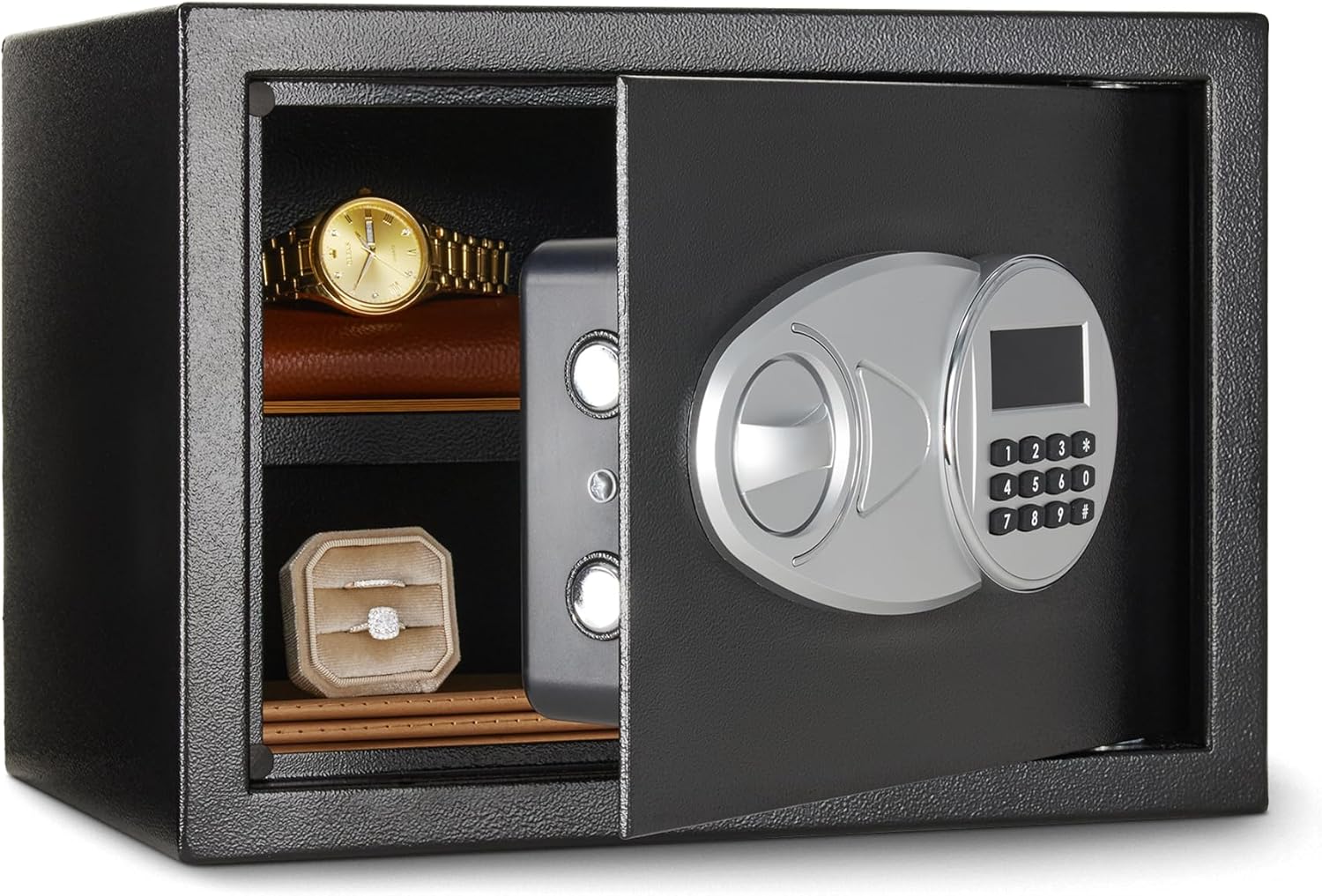
Amazon Basics Steel Security Safe and Lock Box, 0.5 Cubic Feet
This is the smaller of the two Amazon Basics units, and its job is narrow on purpose: documents, a passport, a few pieces of jewelry, a spare key you do not want living in a kitchen drawer. The 0.5 cubic foot interior is roughly a shoebox with ambitions, which is fine, because a safe that tries to be everything usually holds nothing well. The removable shelf is more useful than it sounds. Papers on the bottom layer, small hard items on top, and you are not excavating a stack of envelopes every time you need a birth certificate.
The electronic keypad is the honest middle ground in this lineup. Digital keypads are faster than a dial and less temperamental than a fingerprint sensor, and they do not care whether your hands are wet or cold. What you should verify before buying is the key override and the lockout behavior after wrong codes, because that is where inexpensive keypads cut corners.
Where I push back: this is a box, not a vault. A 0.5 cubic foot safe that is not bolted down is portable, and the carry handle is a feature for the person stealing it as much as for you. Anchor it to a shelf or a floor, or accept the risk.
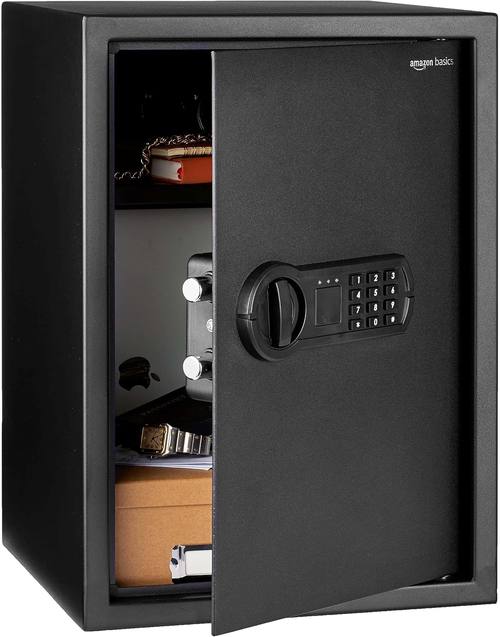
Amazon Basics Steel Home Security Safe Box, 1.8 Cubic Feet
This is the volume pick of the group. At 1.8 cubic feet, with a 13.8 inch width, a 13 inch depth, and a 19.7 inch height, it is the unit that swallows binders, a smaller lockbox of heirlooms, and the documents you genuinely need to keep. The interior height is what separates it from the compact models. You can stack instead of Tetris.
It runs the same keypad family as the smaller Amazon Basics, which means the same advice: the keypad is the convenience and the mechanical override is the insurance. If the override key is a flat, cheap blank, have a better one cut, and keep the original somewhere outside the safe. A key locked inside the safe it opens is a joke I have seen play out more than once, and it is never funny to the owner.
Weight matters more at this size. A taller safe is easier to tip and easier to walk out the door, so anchoring is not optional in my book. Anchor into a floor joist or a concrete slab, not into drywall and hope.
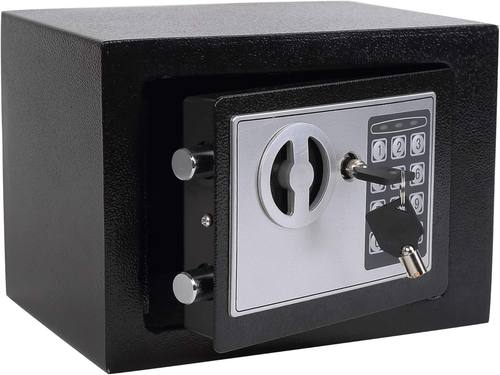
Yuanshikj Small Steel Security Safe Box, 0.23 Cubic Feet
At 0.23 cubic feet, this is the smallest safe in the group, and its best use is not documents. It is a nightstand safe: jewelry, cash, a passport, the small items you currently keep in a dresser drawer that a guest could open in four seconds. It runs on a keypad and it also ships with a key, which is the configuration I prefer in this size class. Two ways in means a dead battery is an inconvenience instead of a crisis.
Small safes have a specific weakness, and it is not the lock. It is the fact that a small safe can be carried out under one arm. If you buy this one, bolt it. A 0.23 cubic foot box anchored into a closet floor is real security. The same box sitting loose on a shelf is a carrying case with a keypad.
The keypad on a safe this size is usually the simplest version of the technology, so keep the code to something you can enter without looking, and change it the moment anyone watches you open it. That advice costs nothing and prevents most of the small-safe failures I see.
Grimtron 20LB Biometric Safe with Fingerprint Lock
Here is the biometric entry: a fingerprint lock plus a three to eight digit PIN, in a 20-pound body. Biometric locks are genuinely fast. When they work, they are the quickest way into a safe, which is exactly what you want at 3 a.m. and exactly what you do not want the day the sensor decides your thumb is a stranger.
Biometrics are convenient and occasionally terrifying. That is not a knock on this specific unit, it is the nature of the technology. A fingerprint reader is a battery-powered computer, and batteries are a single point of failure. If this is the safe you choose, keep the PIN memorized, keep a mechanical key accessible outside the safe, and replace the batteries on a schedule instead of waiting for a warning beep. Convenience that strands you is not convenience.
Then there is the weight. Twenty pounds is light. A 20-pound safe protects against an opportunist and a curious teenager. It does not protect against anyone who arrived prepared. Weight is security, and there is no way around that math. Bolt it into something structural, or accept that it is a deterrent and not a barrier.
The four safes side by side
| Safe | Capacity | Lock | Best for | Price |
|---|---|---|---|---|
 Visit on Amazon → Visit on Amazon →Amazon Basics Steel Security Safe and Lock Box |
0.5 cu ft | Electronic keypad | Documents, passports, shelf organization | $59.99 |
 Visit on Amazon → Visit on Amazon →Amazon Basics Steel Home Security Safe Box |
1.8 cu ft | Electronic keypad | Volume: binders, document stacks, jewelry | $104.99 |
 Visit on Amazon → Visit on Amazon →Yuanshikj Small Steel Security Safe Box |
0.23 cu ft | Keypad plus key | Nightstand, drawer replacement, small items | $29.99 |
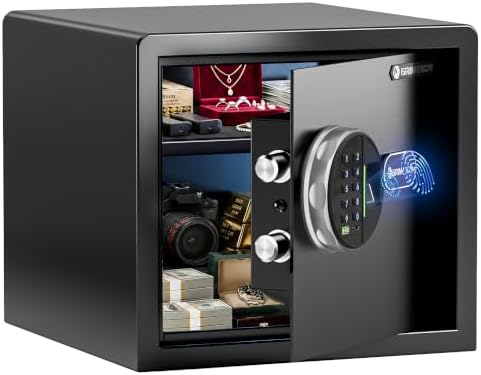 Visit on Amazon → Visit on Amazon →Grimtron 20LB Biometric Safe |
20 lb body, capacity not listed | Fingerprint plus 3-8 digit PIN | Fast access, biometric convenience | $94.99 |
What the table does not tell you
Capacity is the number everyone compares and the number that matters least. A 1.8 cubic foot safe with a weak lock is worse than a 0.5 cubic foot safe with a good one, because the bigger box holds more of what you would cry about losing. Buy the lock first, then buy the cubic feet.
If you need fire protection
None of these four is sold on a named fire rating, and a listing that says fireproof without a temperature and a time is marketing, not a measurement. If your priority is paper surviving a house fire, buy a safe that states a rating in hours and degrees, and keep documents in a sealed bag inside it anyway. Smoke and water damage do not care about your sticker.
Should you buy the Amazon Basics 1.8 cubic foot safe?
If you need volume, yes. It is the largest unit here, the interior height lets you stack instead of cram, and it uses the same keypad family as its smaller sibling. The caveat is weight and anchoring. A taller safe tips and walks more easily, so bolt it into a floor joist or a slab, and treat the keypad as the convenience while the mechanical override is the insurance. If your documents live in a filing cabinet right now, this is the upgrade that changes your risk.
Should you buy the Grimtron 20LB biometric safe?
Only if speed is your priority and you understand the trade. Fingerprint entry is the fastest way into a safe, and the PIN gives you a backup path when the sensor refuses you. But 20 pounds is light, and a battery-powered lock is a single point of failure. Keep the PIN memorized, keep a key outside the safe, replace batteries on schedule, and bolt the unit down. Do those four things and it is a useful safe. Skip them and it is a carrying case with a fingerprint reader.
The bottom line
Buy the safe for the threat you actually face. For most households that is a smash-and-grab, not a professional crew, and the answer is a bolted-down safe with a tight door gap and a lock that does not give up to a cheap tool. The 1.8 cubic foot Amazon Basics handles volume. The 0.5 cubic foot Amazon Basics and the Yuanshikj handle the small stuff, with the Yuanshikj winning on the key backup in a tiny footprint. The Grimtron buys you speed at the cost of weight and battery dependency. Pick the one that matches your threat, then bolt it down. The bolt is the part nobody sells you and the part that decides whether the safe is still there when you get home.