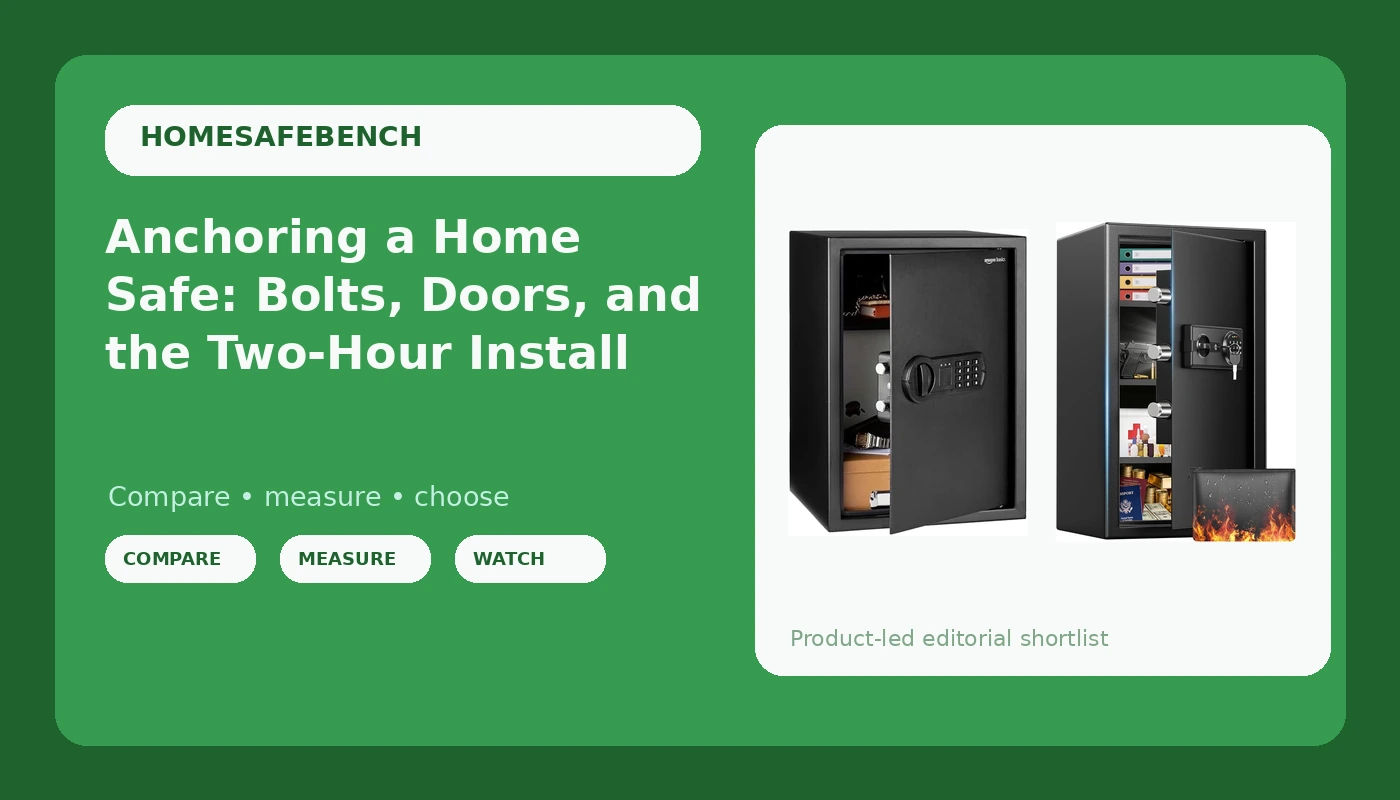
Most home safes get bought the same way. Somebody walks into a big box store, looks at a row of black steel boxes with keypads, picks the one that fits the shelf, and hauls it home. It lands on the closet floor. The factory code stays set, the override key goes in the junk drawer next to it, and nothing anchors it to anything.
That is not a safe. That is a heavy box with a suggestion of security, and I have opened hundreds of them.
Installing a home safe properly is a two-hour job, and almost none of that time goes into the box itself. It goes into where you put it, how you bolt it down, what code you set, and whether the door gap on the thing is tight enough that a crowbar has nothing to bite. Get those four things right and a modest safe beats an expensive one sitting loose in a bedroom.
Here is the whole process, in the order I would do it in my own house.
Why you should trust me
I have been a locksmith in Boise for 25 years. I have opened more safes than the manufacturers would like to admit, including a few the owners swore were impenetrable, and I keep a workshop notebook that tracks which locks fail under which tools.
My method on any safe is the same. A 24-inch crowbar at the door gap. A drop test on a concrete floor. A lock manipulation session with hand tools and feel, the old-school way, because a lock that opens by feel for me is a lock that opens for someone else with patience.
I do not write about gun safes. That is a different liability lane with a different set of ratings and a different set of laws. This is about the document and valuables safe in your closet, which is the safe most households actually buy.
How I judge a safe before I recommend one
The lock is the safe. A five hundred dollar box with a two dollar lock is a steel box with a suggestion, and the keypad on the front is the first thing I evaluate.
The lock. Digital keypads are the honest middle ground. They are fast, they do not care about a wet thumb, and they fail in predictable ways. Biometric locks are genuinely convenient and occasionally terrifying, because the battery and the sensor are both single points of failure, and I have watched a reader give up on a finger that was too dry. Mechanical dials never run out of power, but nobody under 40 wants to spin one twice a day.
The door gap. A tight gap is half the security. Pry resistance comes from the gap and the bolt work, not from the thickness printed in the brochure. Take a business card and walk it around the door seam. If it slides in deep on any side, a crowbar will find the same space with more leverage than your fingers.
The bolt work. The metal that actually holds the door. More bolts is better, but only if they are live bolts that seat into the frame when the door closes. A row of decorative studs on the hinge side does nothing.
Weight and anchoring. Weight is security. A 20-pound safe is a theft convenience for someone with a dolly and a set of stairs. If you cannot add weight, you add anchoring, and anchoring is cheaper than steel.
The fire rating fine print. A fire rating is minutes at a specific temperature. A one-hour rating at 1,550 degrees means something only if the test was real and the standard is named. The same rule applies to water. A waterproof claim without a depth and a duration is a marketing sentence, not a measurement.
The keypad's appetite. Keypads that eat batteries in a month are the number one complaint I hear on service calls. Ask what the override is and where it lives before you buy.
The two safes I would actually put in a house
Most households need one of two things: a small box for documents, passports, and jewelry, or a larger unit for everything that will not fit in a drawer. The two below cover both ends, and neither one requires a professional install.
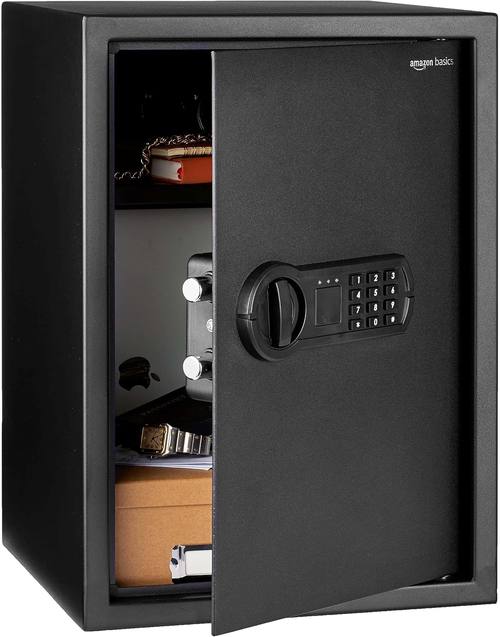
Small-space pick: Amazon Basics Steel Home Security Safe Box with Electronic Keypad Lock for Documents, Jewelry, Valuables, 1.8 Cubic Feet, Black, 13.8"W x 13"D x 19.7"H
 Visit on Amazon →
This is the box I point people toward when they want a document and jewelry safe that fits on a closet shelf or in the bottom of a wardrobe. At 1.8 cubic feet with a footprint of 13.8 inches wide by 13 inches deep and 19.7 inches tall, it slides into the kind of space most houses already have, and the steel body with an electronic keypad is the configuration I trust more than a biometric reader at this size.
The honest caveat is the same one I give on every safe in this class. Read the product page carefully for what the manufacturer claims about fire and water protection before you treat it as a document vault, because a steel box with a keypad is not automatically a fire safe. If your priority is paper that must survive a house fire, either add a rated document bag inside or step up to a unit that publishes a rating. For jewelry, passports, backup drives, and the things a smash and grab thief would pocket, this does the job.
Two setup notes that matter more than the box. The keypad runs on batteries, so put a reminder in your phone to change them before they die, and store the override key somewhere that is not the junk drawer beside the safe. The other note is anchoring, covered below. Check current Amazon price, then add the cost of a bolt kit to your mental total.
Flaws but not dealbreakers: The capacity is real but unforgiving. Binders and oversized folders will not fit, and stacking paper to the ceiling of the interior wastes the depth. Measure what you plan to store before you commit.
Anyone in an apartment or a smaller house who needs documents and jewelry locked up, and who will actually bolt the thing down, will be well served here.
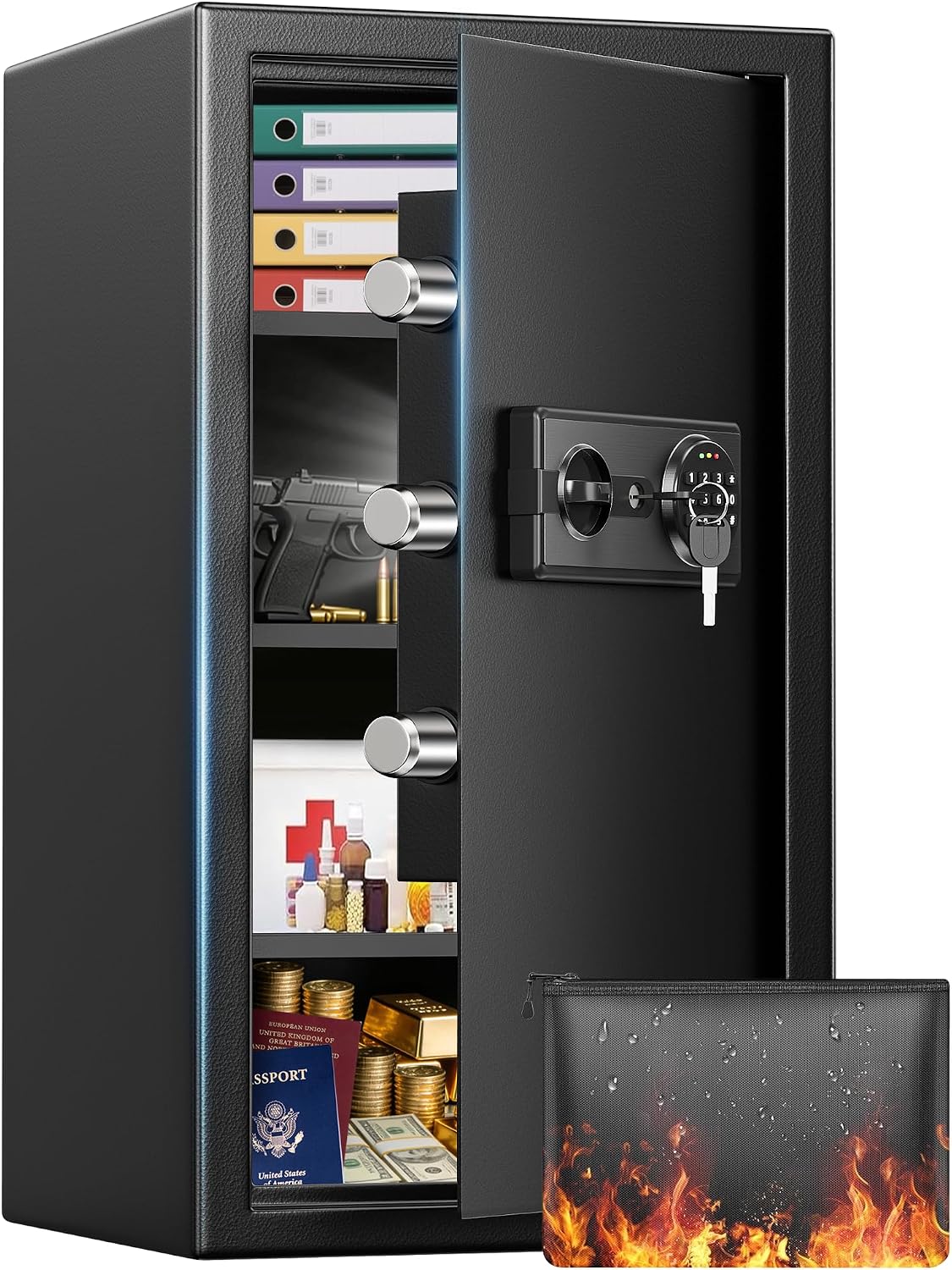
Whole-house pick: 6.1 Cu Ft Large Home Safe Water and Fireproof with Digital Keypad & Key
 Visit on Amazon →
When a household has more than a shoebox of paper, this is the size that stops the arguments. Six point one cubic feet is enough for deed folders, birth certificates, insurance paperwork, a few albums, backup drives, and the jewelry box, with room left over for the things you would rather not list. It carries both a digital keypad and a key, which is the combination I want in a primary safe: a keypad for daily access, a key for the day the keypad quits.
The fire and water claims are where you do your homework, and I mean that in your favor. Water and fire protection at this capacity is the reason to buy a unit this size instead of a shelf box, but a claim is only as good as its fine print. Look for a stated standard, a temperature, and a duration. If the listing gives you minutes at a specific temperature, you can compare it to the other safes on your shortlist. If it gives you a badge and a color, treat that as marketing and store your irreplaceable paper in a rated document bag inside the safe anyway. Belt and suspenders is the correct posture with fire.
Two practical points. This is a floor safe, not a shelf safe, both because of its size and because of how it will be loaded. And it will arrive heavy, so plan the delivery path before it shows up. Check current Amazon price, and price out anchoring hardware at the same time, because a safe this size that is not bolted down is the easiest large object in your house to walk out with on a hand truck.
Flaws but not dealbreakers: Large interior volume invites overloading, and a door that will not latch because a folder is pinched in the frame is a self-inflicted lockout. Keep the top inch of the interior clear.
Anyone consolidating a whole household's documents and valuables into one unit, with floor space and a helper for the install, should start here.
Where to put it
Placement decides more of your outcome than the brand on the door.
Concrete slab beats a wood subfloor. A safe on a garage or basement slab is anchored to the house itself. A safe on a second-floor bedroom subfloor is anchored to plywood, and plywood loses.
The master bedroom closet is the first place a smash and grab crew looks. It is also the first place they check for a safe. If you have a less obvious closet, a utility room, or a basement corner that stays dry, use it.
Avoid flood zones and under-sink plumbing. Water damage ruins paper as thoroughly as fire does, and a slow leak you never notice is worse than a burst pipe you do.
Avoid the garage if it swings below freezing and above 100 degrees. Temperature swings are hard on electronics, gaskets, and anything with a battery.
Leave working room. You need the door to open fully and you need to be able to get your body in front of it. A safe wedged into a corner so the door only opens 60 degrees is a safe you will stop using.
Anchoring, the step that decides whether the safe matters
This is the part everyone skips, and it is the part I would do first.
Step one: empty it and open the door. Never drill, move, or tip a loaded safe.
Step two: find your fastening points. On a slab, you are drilling into concrete. On a wood floor, you want to land on a joist or add a plywood backer that spans two joists. Through the back wall into studs is the other option, and it is a good one for a shelf-size unit.
Step three: mark the holes through the safe's own mounting holes. Use a pencil or a marker through the floor of the safe so the marks line up with reality instead of with your tape measure.
Step four: drill with the right bit. A masonry bit and a hammer drill for concrete, a standard bit for wood. Go slightly deeper than the anchor needs.
Step five: set the anchors and tighten evenly. Expansion anchors for concrete, lag bolts for wood. Snug them in a cross pattern so you do not warp the safe's floor plate. If the door starts dragging after you tighten, you have pulled the body out of square, so back off and shim.
Step six: test the door. Open and close it a dozen times. Check the gap on all four sides. If the gap opened up on one side, the anchor job is wrong and the pry resistance you paid for just left the building.
If you rent and cannot drill, a heavy safe plus a cable lock around a structural element is a compromise, not a solution. Say that out loud to yourself before you buy.
Setting the code and the override
Do all of this with the door open. Every lockout story I have ever heard starts with someone testing a new code with the door shut.
Read the manual for your specific model. Code lengths, reset procedures, and lockout delays vary. Do not guess, and do not assume the procedure from another safe applies.
Change the factory code immediately. A default code is a published code, and the first page of the manual is not a secret.
Test the new code three times with the door open. Then test the key override with the door open. Both paths have to work before you trust the safe with anything.
Store the override key off the safe and out of the same room. Not taped to the back, not in the drawer underneath it. A key beside the safe is a key the thief already found.
Put the battery change on a calendar. Annual is a reasonable default, and if your keypad has a low battery warning, believe it the first time.
Keep a desiccant pack inside if you store paper or electronics. Humidity is slow, quiet damage.
What goes in, and what should not
Good candidates: passports, birth certificates, deeds, titles, insurance policies, a written inventory with photos, backup drives, jewelry you do not wear weekly, and a modest amount of cash.
Poor candidates: anything you need every day, since daily access is how doors get left open, and anything you cannot replace if the entire safe walks out the door. A safe is a delay device, not a guarantee, and I will not pretend otherwise. Keep the truly irreplaceable items duplicated somewhere else, whether that is a bank box, a relative's house, or a scanned copy in encrypted cloud storage.
One more rule: if it is not bolted down, do not put your grandmother's rings in it. You are not protecting them from a burglar, you are packaging them for one.
The realistic setup order
- Measure the space and the doorway before you buy.
- Clear the location, and confirm the floor or wall can take anchors.
- Have a helper for anything over 50 pounds.
- Move the safe into place and open the door.
- Mark and drill the anchor holes.
- Anchor, then test the door swing and the gap.
- Change the factory code and test both entry methods with the door open.
- Load it, add desiccant, and put the battery reminder on the calendar.
What this all costs
I am not going to quote you prices that will be stale by the time you read this. Check current Amazon price on whichever unit fits your space, then add the things nobody budgets for: a proper anchor kit, a desiccant pack or two, a rated document bag if you want a second layer of fire protection for paper, and a locksmith service call if you lock yourself out. That last one is the only line item that is entirely optional and entirely within your control, because you are going to test the code with the door open.
The cost per day math on a safe is almost always flattering, because you buy it once and it sits there for 20 years. The expensive mistake is not the safe. It is buying the wrong size, putting it in the wrong room, and never anchoring it.
What I left out of this guide
Gun safes are out of scope. Different ratings, different laws, different liability, and a different guide.
Bank safe deposit boxes are a real alternative for documents and I recommend them alongside a home safe, not instead of one. The point of a home safe is access on the worst day of your life, when the banks are closed or the roads are under water.
Wall safes and floor safes are legitimate options if you are remodeling and can plan for them. In an existing house, a freestanding anchored safe is almost always the better trade.
The bottom line
Buy the safe for the threat you actually face. For most households, that is a smash and grab, not a professional crew with tools and time. Against a smash and grab, the winning combination is simple: a decent lock, a tight door gap, a code nobody else knows, and a safe bolted to something that will not move.
The lock is the safe. The anchor is what makes the lock matter. Do the two hours of work, and the box in your closet becomes something a thief has to think about instead of something they carry out.