Most people buy a safe, set it on a closet shelf, put the override key on top of it, and call the job done. That is not a fireproof home safe setup. That is a steel box with a suggestion, parked at chest height where any thief with two hands can carry it out the front door.
I have been a locksmith for 25 years out of Boise, and I have opened more safes than the manufacturers would like to admit, including a few the owners swore were impenetrable. The pattern is always the same. The lock was cheap, the door gap was wide enough to park a crowbar in, and nobody bolted the thing down.
The good news is that the setup work is not complicated. It is about an hour of measuring, drilling, programming, and writing things down. Do that hour correctly and a mid-priced safe outperforms an expensive one that got dropped on a shelf and forgotten.
Here is the sequence I would walk a customer through, and the two safes I would start that conversation with.
Why you should trust me
I have run pry tests with a 24-inch crowbar on consumer safes for most of my career, followed by a drop test and a lock manipulation session on the same unit. I keep a workshop notebook of which locks fail under which tools, and I have never once written "burglar-proof" in it, because nothing is.
I do not sell safes. I open them, I install them, and I tell people when the safe they already own is doing its job and when it is theater. That is the whole business model.
The four questions I ask before I recommend a setup
Every safe gets the same evaluation, and it has nothing to do with the brochure.
One, what is the lock? The lock is the safe. A heavy door with a two-dollar lock is a heavy door that opens in ten minutes.
Two, can I pry the door gap? Pry resistance comes from the door gap and the bolt work, not the thickness of the marketing copy. A tight gap with decent bolts beats a thick door with sloppy tolerances every time.
Three, what does the fire rating actually say? A fire rating is minutes at a specific temperature. If the fine print is vague, the rating is decoration.
Four, would I trust it with someone's irreplaceable documents? That is the real test. If the answer is no, it is a deterrent for a watch and a passport, not an archive.
I have not put a crowbar to the two units below. I am evaluating them on the same four questions using what the manufacturers document and what the design says out loud, and where a claim cannot be verified from the listing, I say so instead of dressing it up.
The two safes worth building a setup around
These two cover the two jobs people actually have. One is for paper that has to survive heat. One is for the things you need to reach in a hurry, with three ways in when the electronics misbehave.
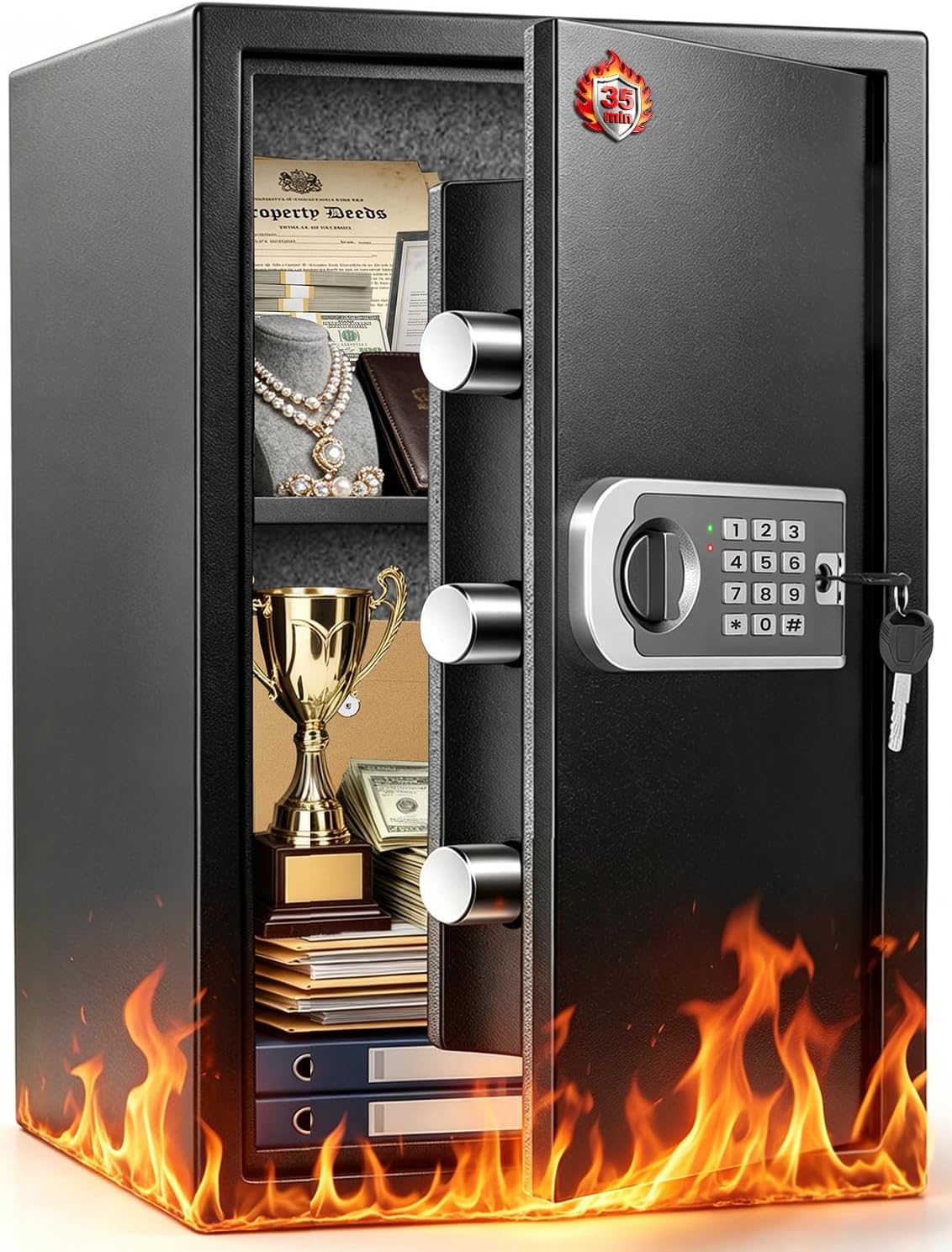
Fire-rated pick: 𝐔𝐩𝐠𝐫𝐞𝐝𝐞𝐝 2026 Fireproof Safes for Home| 1700°F 35-Min Protection
 Visit on Amazon →
This is the one I would point a client toward when the contents are documents: deeds, passports, insurance paperwork, birth certificates, the stuff that costs months and lawyers to replace. The listing puts the protection at 1700°F for 35 minutes, and that is a document rating, not a promise that the fire department arrives inside the window. Read it that way and it is a genuinely useful number. Read it as "fireproof" and you will be disappointed, because no consumer box is fireproof in the absolute sense.
The design is a home safe first, which matters. It is built to sit in a closet or a home office, and the setup question with a safe like this is not whether it is heavy enough to stop a professional crew, because it is not. The question is whether it is anchored well enough to stop the smash-and-grab that actually happens in a residential burglary, which is a person with a flashlight and about four minutes.
Flaws but not dealbreakers: A fire rating means nothing if the safe is not closed all the way. The seal only works with the door seated, and a document safe that gets loaded so full the door rests on paper is a document safe with a leak.
Check current Amazon price before you commit, and confirm the anchoring hardware you need for your floor type is in the box.
Anyone whose priority list starts with paper that must survive heat should start here.
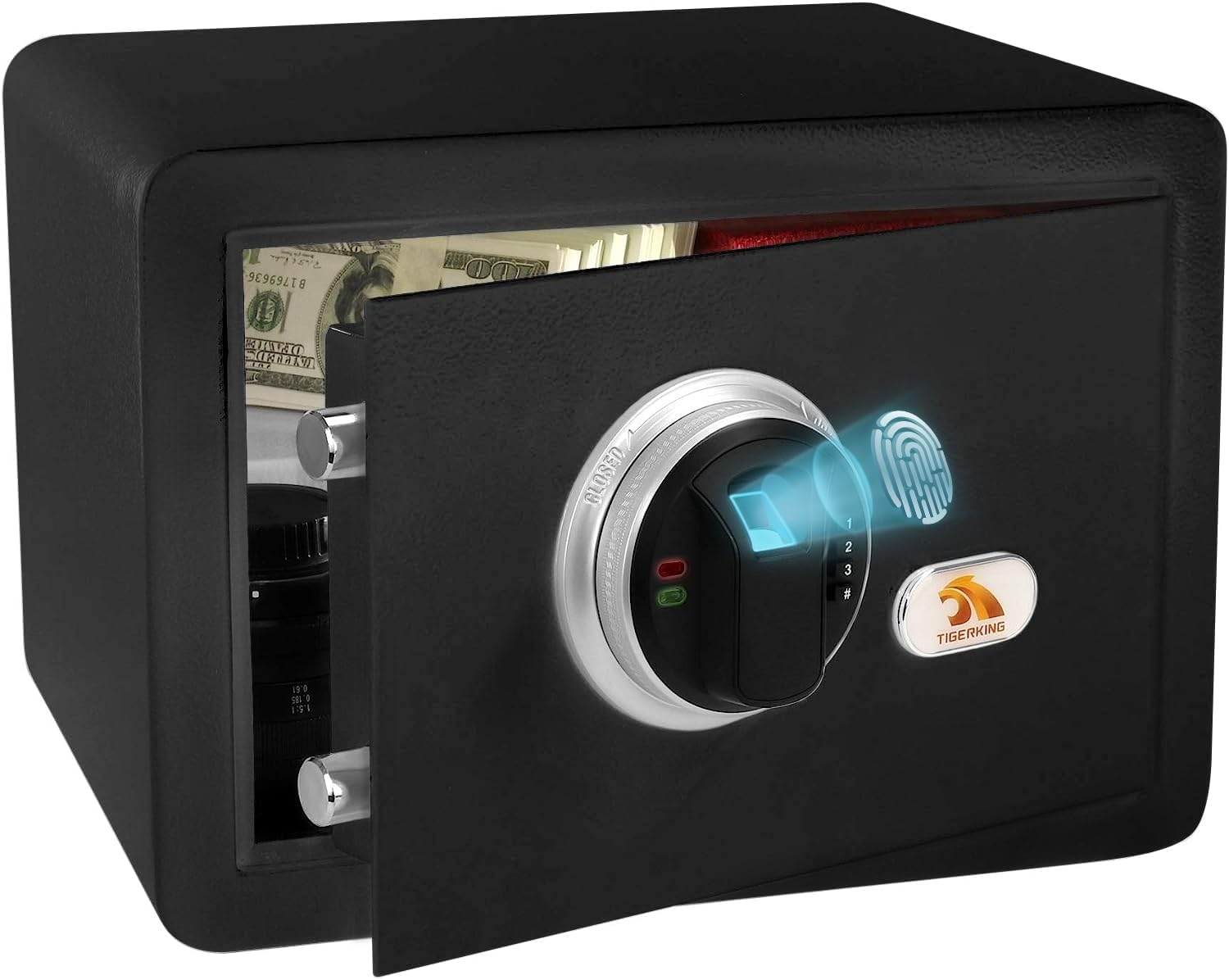
Everyday pick: TIGERKING Biometric Small Home Safe with key and digital keypad
 Visit on Amazon →
Three ways in: biometric, digital keypad, and a physical key. That redundancy is the reason this one is on the list instead of a biometric-only box. Biometric locks are convenient and occasionally terrifying, and the failure mode is always the same, which is a dead battery and a fingerprint reader that will not wake up. Having a keypad and a key behind it turns a crisis into an inconvenience.
The digital keypad is the honest middle ground here. It is fast enough for daily access, it does not depend on a fingerprint reading cleanly after you have been in the garden, and it is the credential I would use for a household with more than one adult. The biometric is for the person who wants in during a two-second window.
Flaws but not dealbreakers: Small means small. This is a safe for a handgun-free household's jewelry, cash, and a couple of folders, not an archive. If you are stuffing it with documents, buy the fire-rated unit above and use this one for what you need quickly.
Check current Amazon price and confirm the interior dimensions against the largest item you plan to store before ordering.
Anyone who wants fast access with a mechanical fallback will be happy with this one.
The setup workflow, step by step
Now the part that determines whether either safe above does its job.
Step one: decide the contents before the location. Write down what is going in. Documents that must survive fire go in the fire-rated unit. Things you need weekly go in the fast-access unit. Mixing the two is how people end up with a passport behind a biometric reader that eats batteries.
Step two: pick a location with an interior wall behind it. An interior closet wall, ideally on the lowest floor you can manage, away from the garage and away from exterior walls. Garages burn hot and fast, and a safe rated for 35 minutes at 1700°F is being tested by a garage fire in ways a closet fire is not.
Step three: confirm the floor can carry it and the door can swing. Measure the door swing with the safe loaded, not empty. A safe that opens into a shelf is a safe you will stop using.
Step four: anchor it. This is the step everyone skips. Bolt into floor joists, a concrete slab, or wall studs, using hardware rated for the load. Weight is security, and an unanchored safe loses its weight advantage the moment someone brings a hand truck.
Step five: level it and check the door gap. A safe that is out of level can bind the bolt work. Close the door, look at the gap around the perimeter, and make sure it is even. A tight, even gap is half your pry resistance.
Step six: change every factory credential. Factory default codes are published. Set your own keypad code, enroll your own fingerprints, and delete anything that shipped enrolled.
Step seven: deal with the override key honestly. The key belongs somewhere outside the room, ideally outside the house, in a place you can reach without a locksmith. A key taped to the side of the safe is a key for the thief, not for you.
Step eight: load it without blocking the bolts. Nothing should touch the door or press against the bolt work when the door closes. That is how a safe ends up with a door that will not open on a Sunday night.
Step nine: write down what is inside and photograph it. Keep that list somewhere other than the safe. Insurance claims are won with documentation, not with memory.
Step ten: put battery replacement on a calendar. Keypads that eat batteries in a month are a pet peeve of mine, and the fix is a scheduled swap, not a hope. Change them annually whether they need it or not.
What not to do with a home safe
Do not bolt a fire-rated document safe to a garage wall and call it protected. Do not store the override key in the same room as the safe. Do not trust the phrase "military grade" on a budget box, because it means nothing on a safe that costs less than a set of tires. Do not overstuff the door. And do not skip the anchor because the safe feels heavy, because 20 pounds is a theft convenience for anyone with a dolly.
The competition and why it lost
The budget big-box keypad box is the most common safe in America and it is not on this list, because the locks are basic and the fire claims are usually vague. Fine for a deterrent, wrong for anything you would cry about losing.
The hotel-style electronic safe with a thin door and a single solenoid latch is a convenience product, not a security product. It opens with a bounce and a screwdriver in the wrong hands.
Biometric-only boxes are fast and impressive right up until the battery dies or the sensor smears. Redundancy wins.
And gun safes are a different liability lane entirely. That is a separate conversation with different rules, and this is not that guide.
What this all costs
Safe prices move constantly, so Check current Amazon price on both units rather than trusting a number you read in a review. What does not move is the rest of the setup: a proper anchor kit and bolts, a fire bag for the documents inside the fire-rated safe, and an hour of your Saturday.
Do the math on a five-year horizon, because that is roughly how long a decent safe stays in one place. Divide whatever you pay today by 1,825 days and compare it to the cost of replacing a passport, a deed, and a folder of birth certificates from scratch. The safe wins every time, and it wins by a wider margin when it is bolted down, leveled, and loaded correctly.
That is the job. Buy for the threat you actually face, which for most people is a smash-and-grab and a house fire, not a professional crew with a plasma cutter. Then spend the hour. The lock is the safe, but the setup is what makes the lock matter.