Most people buy a safe in the wrong order. They pick a size, check the price, and only later ask whether the door can be pried, whether the box can be carried out of the house, and what the word "fireproof" on the label actually promises. A home safe security setup is really three decisions stacked on top of each other: what holds the door shut, how much the box weighs and whether it is attached to the building, and what the fire claim covers. Get those three right and a modest cabinet does real work. Get them wrong and you have bought a heavy box with a lock-shaped suggestion on the front.
Related: How to Anchor a Safe to a Concrete Floor →
Quick answer
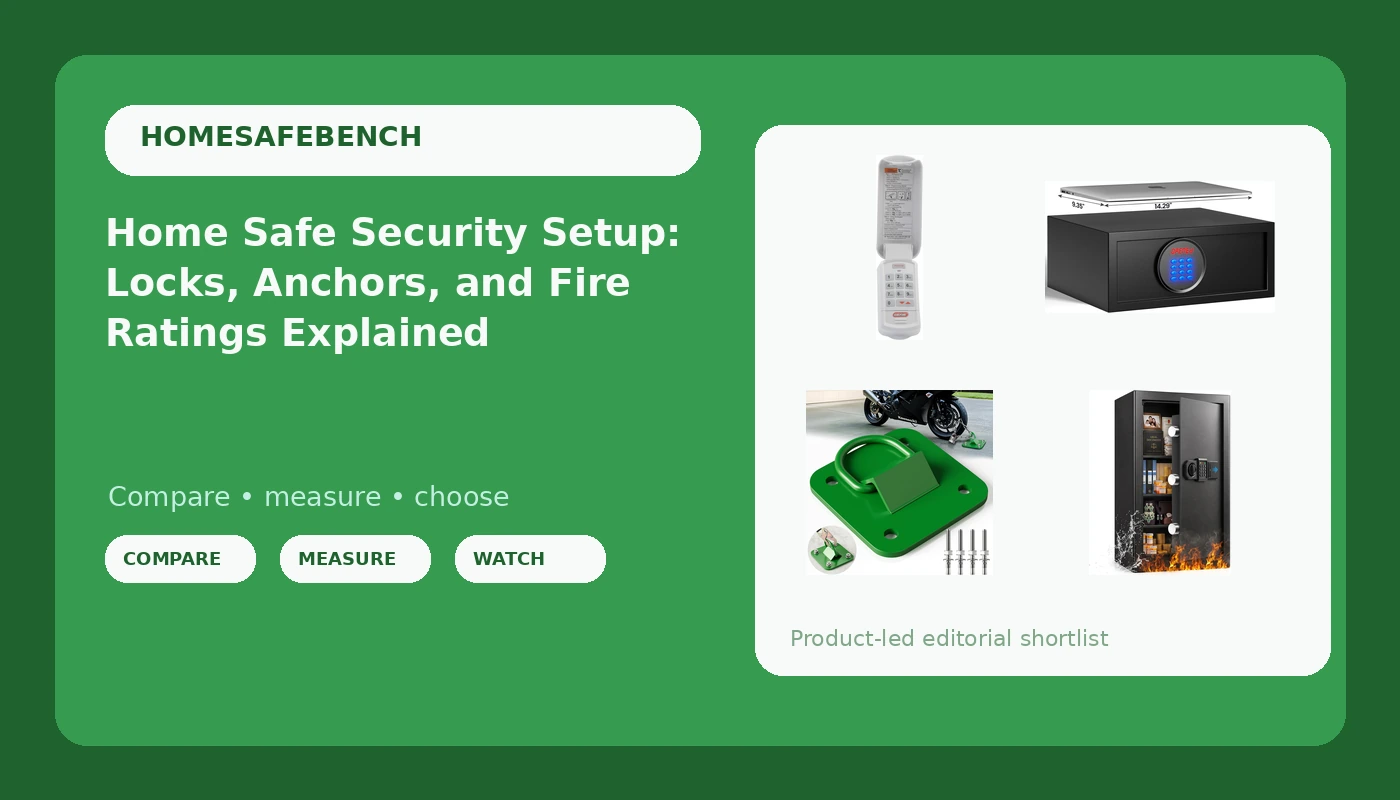
For most households the order of priority is anchoring first, lock quality second, fire rating third, and capacity last. Among the options here, the 7.0 Cuft Large Fireproof Safe for Home is the bulk storage pick, the KornerBatl 19.4 lb Hotel & Dorm Safe Box with Admin Password is the small-space pick for a laptop and paperwork, the Genie Wireless Keyless Keypad (Model GK-R) removes the hidden garage key from the equation, and the D Ring Anchor Plate is the hardware that gives a safe something solid to be bolted to. None of these is burglar-proof, and no consumer safe is. The goal is to make an easy theft hard and a hard theft slow.
Four useful options
| Model | Best fit | What stands out |
|---|---|---|
| 7.0 Cuft Large Fireproof Safe for Home | Households with file boxes, binders, and bulk valuables | 7.0 cubic feet of interior volume, marketed as a fireproof home safe |
| KornerBatl 19.4 lb Hotel & Dorm Safe Box with Admin Password, Laptop Safe | Dorms, rentals, and small apartments | A 19.4 lb cabinet with an admin password function and laptop-sized interior |
| Genie Garage Door Opener Wireless Keyless Keypad, Model GK-R | Replacing the hidden key with PIN entry | Listed as compatible with all Genie Intellicode garage door openers |
| D Ring Anchor Plate, Reusable Concrete Anchor Plate, 1 Pack | Adding a fixed anchor point in concrete | A reusable concrete anchor plate sold as a single pack |
The large-capacity option: 7.0 Cuft Large Fireproof Safe for Home
Volume changes the security math. A large cabinet has more door surface to flex and a longer door gap for a pry bar to find, which is why bolt work and door fit matter more as the box gets bigger. It also invites the mistake people make with every large safe: filling it with light, bulky items and leaving it sitting unbolted in a closet. Check the anchor holes before you commit to a location, and decide the location before the safe arrives, not after.
The compact laptop safe: KornerBatl 19.4 lb Hotel & Dorm Safe Box with Admin Password, Laptop Safe
At 19.4 pounds, this is a portable box, and portability is the whole trade-off. It solves the "I do not want my laptop sitting on a desk in a shared building" problem well, and it does very little against someone who walks in with a bag and thirty seconds. If it stays in one place, bolt it or cable it to something structural. If it travels with you, treat it as a lockbox, not as a safe, and keep the truly irreplaceable items somewhere else.
The garage access add-on: Genie Garage Door Opener Wireless Keyless Keypad, Model GK-R
The hidden key is the weakest link in a lot of homes, and a keypad is the honest fix. Two things to plan for. First, exterior keypads live on batteries, so put a battery change on a calendar rather than waiting for a dead pad on a rainy night. Second, a PIN is only as private as the people who know it, so change it when a contractor, a sitter, or a neighbor no longer needs it. If the garage leads into the house, the keypad is part of your perimeter, and the perimeter is where safes get defeated before anyone ever touches the safe.
The anchoring hardware: D Ring Anchor Plate, Reusable Concrete Anchor Plate, 1 Pack
An anchor plate is not a substitute for bolting a safe through its own floor or back wall, but it solves the case where the safe has no usable mounting holes or where the floor is the only solid thing available. A plate set into concrete gives you a hard point for a security cable, chain, or bracket. Concrete is the good news here. Wood subfloor is not, because a determined thief can cut the subfloor around the bolts, and a safe lag-bolted to a joist is only as strong as the joist.
Prices and availability may change. Product images, names, and retailer links are matched to verified listings. No current price, rating, stock status, or measured result is stated here without current evidence.
Why weight and anchoring decide the theft question
Pry resistance comes from the door gap and the bolt work, not from the thickness of the brochure. When someone attacks a safe with a bar, they are looking for a corner or a hinge-side gap they can widen, then for bolts they can shear. A tight door fit and more, thicker bolts make that slow. A wide gap with two small bolts makes it quick. This is why two safes with the same cubic footage can behave completely differently under the same tool.
Weight is the second half of the same problem. A 19.4 pound box is a carry item. A large cabinet is a two-person, dolly-assisted item, and that is the entire difference between a theft that takes thirty seconds and one that takes several noisy minutes. Anchoring is what converts a heavy box into a heavy box that stays put. Bolt through the safe floor into a concrete slab when you can, through the back wall into studs when you cannot, and use a concrete anchor plate and a hardened cable or chain when the safe itself has no usable mounting points. Whichever route you take, keep the safe out of sight from windows and doors. A safe nobody knows about is a safe nobody plans around.
Reading a fire rating without getting fooled
A fire rating is minutes at a specific temperature, and it means something only if the test was real. The word "fireproof" on a listing is marketing language, not a measurement. What you want to find is the rated duration, the temperature the interior is held below, and what the rating covers, because paper, photographs, and digital media all fail at different temperatures. A safe rated to protect paper documents is not automatically rated to protect a hard drive, a thumb drive, or a stack of family photos.
The other half of fire protection is what happens after the fire. Insulation that holds up under heat can still leave the interior humid, and moisture does its own damage to documents over weeks and months. If what you are protecting is irreplaceable, scan it, photograph it, and store a copy somewhere else as well. A safe is a second layer, never the only one.
- Identify the lock type first. Mechanical dial, digital keypad, or biometric, each fails differently and each has a different override story.
- Look at the door gap and the bolt work. A tight gap and more bolts are worth more than a thicker door panel.
- Read the fire rating fine print for duration, interior temperature, and what media it covers.
- Weigh the empty cabinet and decide honestly whether it needs anchoring, then check for pre-drilled mounting holes.
- Match interior volume to what you actually store, and buy for the box you will still own in ten years.
Practical setup notes that cost nothing
- Place the safe where an attacker has to work in the open, and keep it out of the line of sight from any window.
- Bolt it down, or accept that it is portable. If the floor is concrete and the safe has no mounting holes, use an anchor plate.
- Change every factory default code on day one, including admin and override codes on shared-space boxes.
- Keep spare keys, override keys, and codes somewhere other than the room the safe lives in.
- Put keypad and lock batteries on a calendar, and photograph the contents plus the serial number for your insurance file.
Which option should you choose?
Choose the 7.0 Cuft Large Fireproof Safe for Home when you are storing file boxes, binders, and bulk valuables and you have a floor you can bolt into. Choose the KornerBatl 19.4 lb Hotel & Dorm Safe Box with Admin Password, Laptop Safe when space is tight and the main job is keeping a laptop and small valuables out of casual hands in a shared building. Choose the Genie Garage Door Opener Wireless Keyless Keypad, Model GK-R when the weakest point in the house is a spare key hidden outside and you want PIN entry instead. Choose the D Ring Anchor Plate, Reusable Concrete Anchor Plate, 1 Pack when you need a fixed hard point in concrete for a safe that cannot be bolted through its own shell.
Two limits apply to everything above. No consumer safe stops a determined thief with the right tools and enough time; anchoring raises the cost of the attempt rather than eliminating it. And fire protection is a measured claim, so verify the rating language in the listing instead of trusting the word "fireproof" on a box.
The bottom line
A home safe security setup is a system, not a purchase. The lock decides how long the door holds, the anchoring decides whether the box stays in the house, and the fire rating decides what survives afterward. Start with the threat you actually face, which for most people is a smash-and-grab rather than a professional crew, then spend in this order: anchor the box, buy the best lock you can afford, and only then pay for fire protection and extra capacity. The four options here cover the common cases, from a 7.0 cubic foot document cabinet to a 19.4 pound laptop box, a garage keypad that closes the easiest entry point, and the anchor plate that keeps the whole plan from walking out the door.