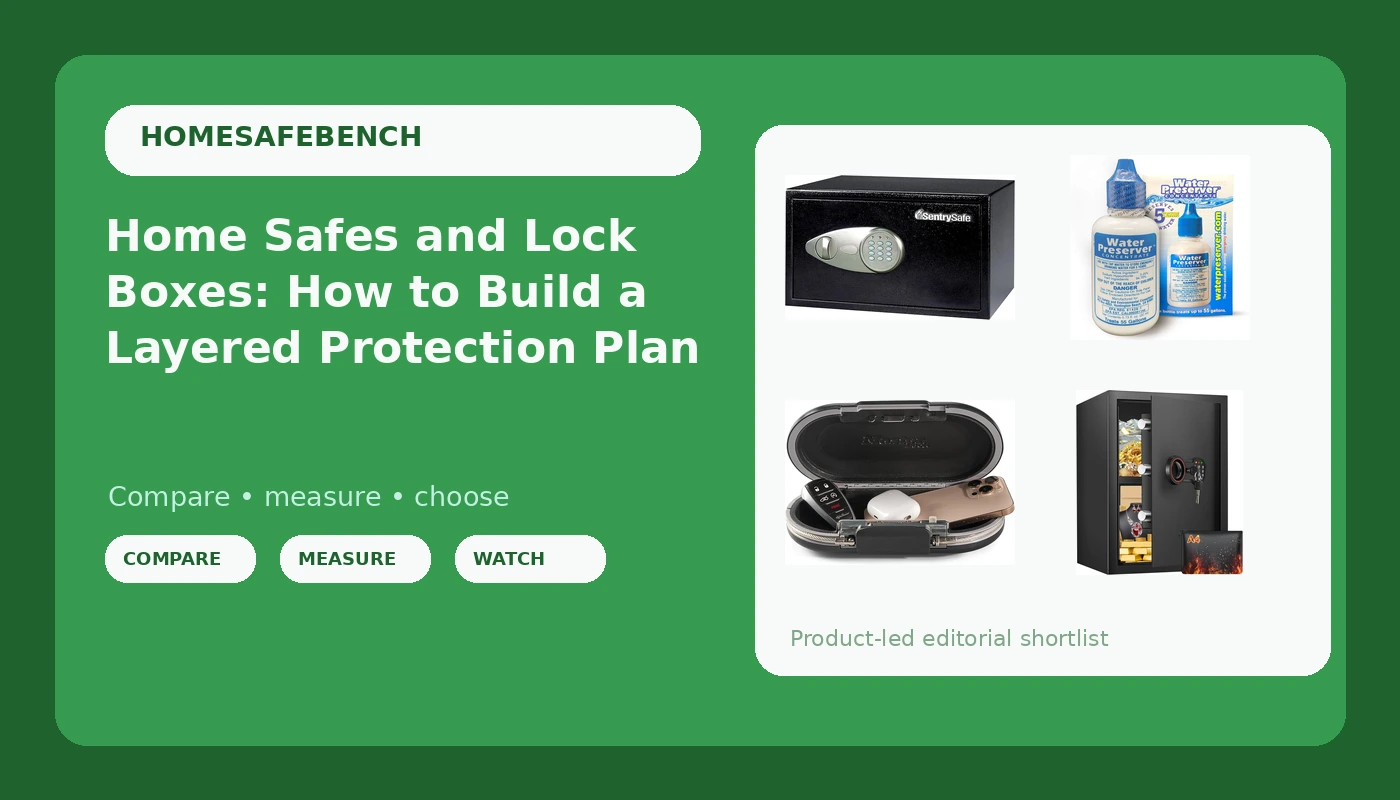
Most people buy a safe backwards. They pick a size and a budget, find a box that fits the shelf, and only then wonder whether the lock, the door gap, or the fire rating is worth anything. After 25 years of opening other people's safes, I can tell you the lock is the safe, and a steel box with a cheap lock is just a suggestion. The smarter approach is to sort your risks first, then compare home safes and lock boxes against them. Documents you cannot replace, valuables you use every week, items that travel with you, and an emergency water supply are four different jobs. No single product does all four well, and pretending otherwise is how people end up with a heavy box that protects the wrong things.
Related: Fireproof Document Safes: What the Ratings Actually Mean →
Quick answer
There is no single product that covers every risk. A large home safe gives you volume for documents and bulky items. A compact keypad safe keeps everyday valuables anchored and organized. A cable-locked travel box protects what leaves the house with you. An emergency water preserver handles the supply side of preparedness, which a safe cannot. Match the product to the threat you actually face. For most households that is a smash-and-grab burglar, a house fire, or a burst pipe, not a professional crew with tools and an afternoon to spare.
Four useful options
| Model | Best fit | What stands out |
|---|---|---|
| [3.3Cub] Large Home Safe Box with Fireproof Waterproof Bag, 19.7" Tall Safe | Documents and bulky valuables at home | 3.3 cubic feet of interior volume, a 19.7-inch tall body, and an included fireproof and waterproof bag |
| SentrySafe Shelf Safe with Digital Keypad Lock, Steel Safe with Interior Lining and Bolt Down Kit for Money, Jewelry, Documents, 0.98 Cubic Feet, 8.9 x 16.9 x 13.6 Inches, X105 | Everyday valuables on a shelf or in a closet | Digital keypad entry, 0.98 cubic feet of space, interior lining, and a bolt-down kit in the box |
| Master Lock Small Travel Safe with Cable, Gray Combination Lock Box, 5900D | Travel and temporary storage | A cable anchor and a combination lock in a box small enough to carry |
| 55 Gallon Water Preserver Concentrate 5 Year Emergency Disaster Preparedness, Survival Kits, Emergency Water Storage, Earthquake, Hurricane, Safety | Emergency water storage | Sized for 55 gallons and described as a five-year preservative for stored water |
The bulk storage safe: [3.3Cub] Large Home Safe Box with Fireproof Waterproof Bag, 19.7" Tall Safe
Volume is the easy part to sell and the hard part to place. A safe this tall needs floor space or a genuinely sturdy shelf, and it needs to be heavy enough, or anchored well enough, that nobody walks off with it. A 3.3-cubic-foot box is a reasonable home for documents, backup drives, jewelry boxes, and the things you would otherwise keep in a shoebox on a closet shelf. The included fireproof and waterproof bag is worth understanding before you trust it. A bag is not the same thing as a rated safe interior. It is a layer. Use it for the papers you would grab first, and treat the safe itself as the structure around them. Anchoring matters more than volume, so plan how you will secure it before it arrives.
The compact keypad safe: SentrySafe Shelf Safe with Digital Keypad Lock, Steel Safe with Interior Lining and Bolt Down Kit for Money, Jewelry, Documents, 0.98 Cubic Feet, 8.9 x 16.9 x 13.6 Inches, X105
SentrySafe is one of the names most people recognize in this category, and the shelf format is a big part of why. It fits where a large floor safe will not, and the keypad gets you in without fumbling for a key at 2 a.m. Digital keypads are the honest middle ground between a mechanical dial and a biometric reader. They are faster than a dial, and they do not depend on a fingerprint sensor that quits when your hands are damp. The trade-offs are real. A keypad needs a battery you have to remember, and a small safe is still a small safe. Use the included bolt-down kit, because 0.98 cubic feet of steel is carryable by one determined person with a bag.
The travel lock box: Master Lock Small Travel Safe with Cable, Gray Combination Lock Box, 5900D
A travel safe is not a home safe, and it should not be sold as one. What it does is raise the effort required for an opportunistic theft. The cable keeps the box from being walked off, and the combination lock keeps it from being opened in a moment. In a hotel room, a rental, or a dorm, that is often the realistic threat. The cable is only as good as what you attach it to, so loop it around something that does not move and cannot be lifted. Keep the irreplaceable things out of a travel box. Put the passport, the spare cards, and the cash you would rather not leave in a nightstand in it, and leave the deed to the house at home.
The water storage companion: 55 Gallon Water Preserver Concentrate 5 Year Emergency Disaster Preparedness, Survival Kits, Emergency Water Storage, Earthquake, Hurricane, Safety
This one is not a lock, and it does not pretend to be. It belongs in the same conversation because a protection plan that covers documents but not drinking water is only half a plan. Stored water goes stale, grows things, and becomes the thing you cannot use when you need it. A preservative concentrate is a low-cost way to extend the life of water you have already put aside. Read the label directions for the ratio and the container you are treating, keep the water out of sunlight, and mark the storage date on every container. If you have never stored 55 gallons, start smaller and scale up once you know how you will rotate it.
Prices and availability may change. Product images, names, and retailer links are matched to verified listings. No current price, rating, stock status, or measured result is stated here without current evidence.
What the lock actually does
Every safe question comes back to the lock. A mechanical dial is slow, reliable, and has no battery to die. A digital keypad is faster, easier for someone to watch over your shoulder, and dependent on power. A biometric reader is quickest of all and the most likely to fail when your hands are wet, cold, or cut. None of them are magic. What matters is how the lock is mounted, whether the bolt work behind it engages properly, and whether the door gap is tight enough that a crowbar has nothing to bite. A solid body with a cheap lock is a weaker product than the price suggests. A good lock on a thin door is the same problem in reverse. Judge the pair, not the sticker.
Fire ratings and honest labels
"Fireproof" is a marketing word. "Rated" is a technical one. A fire rating means a tested time at a tested temperature with a tested internal limit for paper or media, and the fine print is where the real information lives. A fireproof bag is not a rated safe interior. It is a layer that can help, and it can only help the items you actually put inside it. Water is the other half of the story, because the hose that saves your house can ruin what is inside the box. If documents are the priority, look for a stated rating and understand what it covers, then add a bag for the papers you would grab first. If a listing does not state a rating, assume there is not one.
Here is the order I would work through it:
- Name the threat first. Smash-and-grab, fire, flood, or travel theft, because each one points at a different product.
- Decide what has to stay accessible. Daily items belong in a keypad safe. Documents you touch twice a year belong in a bigger box.
- Measure the space and the path. A safe has to make it through the door and sit somewhere it can be anchored.
- Check the lock and the door gap before the cubic feet. Volume is easy to manufacture. Bolt work and a tight gap are not.
- Add the layer that is not a safe. Water storage, a bag for documents, and a written record of contents kept somewhere else.
Where most home security plans fall apart
- Anchor it or accept that it is portable. An unbolted safe is a heavy box with a handle-shaped future.
- Keep a record of contents and serial numbers outside the safe. The safe protects the item; a photo and a list protect the claim.
- Change the factory code on any keypad or combination lock the day it arrives.
- Treat a fireproof bag as a layer for papers, not as a rating, and keep documents flat so the bag can seal.
- Rotate stored water on a schedule you will actually keep, and label the date on every container.
Which option should you choose?
Choose the [3.3Cub] Large Home Safe Box with Fireproof Waterproof Bag, 19.7" Tall Safe when documents and bulky valuables need a home and you have floor or sturdy shelf space to anchor it. Choose the SentrySafe Shelf Safe with Digital Keypad Lock, Steel Safe with Interior Lining and Bolt Down Kit for Money, Jewelry, Documents, 0.98 Cubic Feet, 8.9 x 16.9 x 13.6 Inches, X105 when the priority is fast access to everyday valuables in a smaller footprint, with a bolt-down kit included. Choose the Master Lock Small Travel Safe with Cable, Gray Combination Lock Box, 5900D when the risk is a hotel room, a rental, or a vehicle and you need protection that travels. Choose the 55 Gallon Water Preserver Concentrate 5 Year Emergency Disaster Preparedness, Survival Kits, Emergency Water Storage, Earthquake, Hurricane, Safety when your plan includes stored water and you want to extend how long it stays usable.
None of these products is burglar-proof, and no consumer safe is. A determined thief with tools and time can defeat most residential containers, and a safe that is not anchored can simply be carried away. The realistic goal is to make the theft slow and loud enough to be a bad decision, and to keep the irreplaceable items in the layer that fits the risk you actually face.
The bottom line
Buy for the threat you actually face. For most households that means one anchored safe for documents and valuables, one small keypad safe for the things you reach for, a cable-locked box for travel, and an emergency water supply that is not glamorous but is the difference between prepared and not. Check what a listing actually states before you assume a rating, an anchoring kit, or a fire claim, and remember that the lock and the door gap decide more than the brochure does. A safe is a delay device, not a guarantee, and a delay device only works when it is bolted to something that does not move.