Related: Best Fireproof Document Safes for the Home
I have been a locksmith in Boise for 25 years, and I have opened more home security safes than most people will ever see in a lifetime. Some I opened for owners who lost a key. Some I opened for owners who swore the thing was impenetrable right up until the door swung wide. What I have learned is boring and useful in equal measure: the lock is the safe. A heavy steel box with a cheap lock is a heavy steel box with a suggestion.
So when somebody asks me which safe to buy, I do not start with cubic feet or with the sticker on the door. I start with the threat. For most households the threat is a smash and grab. Somebody kicks a door, spends four minutes in a bedroom, and leaves with whatever fits in a backpack. You are not defending against a crew with tools, a dolly, and an afternoon. You are defending against speed. That single reframe changes what you should buy, and it changes what you should ignore.
The four boxes below cover the realistic end of the market. One hides inside a wall. Two sit on a shelf or a floor with a keypad. One is designed to be carried. I have worked on every category in this trade, and I will tell you plainly what each one does well and exactly where it stops.
Best Overall: Viking Security Safe VS-52BLX Hidden Wall Biometric Safe
Hiding beats hardening. I will say that until I retire. A thief cannot pry a door gap on a safe he never found. The VS-52BLX is built to sit between wall studs and disappear behind a picture, a mirror, or the back wall of a closet, and that single design decision does more for your security than any amount of extra steel on a box bolted in plain sight.
The biometric reader is the part people ask about. Here is my honest position: biometric locks are fast, and they are occasionally terrifying. They are fast because your finger is the key and you never fumble for anything at 2 a.m. They are terrifying because batteries are a single point of failure. When that reader dies, you are relying on the backup key or on a locksmith, and I am the guy you call in that situation. Register more than one finger. Keep the mechanical backup key somewhere outside the safe. Replace the batteries on a calendar, not on a beep.
If you are handy enough to cut a hole in drywall and hit two studs, this is the safest place in your house to keep documents and jewelry, because it is the last place a rushed thief looks.  Visit on Amazon →
Best Value: Amazon Basics Steel Security Safe and Lock Box with Digital Keypad
This is the safe I would hand to a neighbor who wants one answer and no homework. It is 1.2 cubic feet, it has a programmable digital keypad, and it has a removable shelf, which sounds like a small thing until you own one. A shelf turns one deep cave into two usable layers: passports and documents on top, jewelry and the things you actually touch every week underneath.
Digital keypads are the honest middle ground. A mechanical dial is more reliable and I still keep one in my own shop, but nobody spins a dial every morning. A keypad gets used, and a safe that gets used is worth more than a safe that gets avoided because it is annoying. Just understand the trade. Keypads eat batteries, and the cheap ones eat them in a month. Put a fresh set in twice a year whether it complains or not, and keep the override key out of the house.
The footprint here is 16.9 by 14.6 by 10.6 inches, which is the widest of the two keypad models in this guide. That width matters if you are storing flat documents and want them to lie down instead of curling. 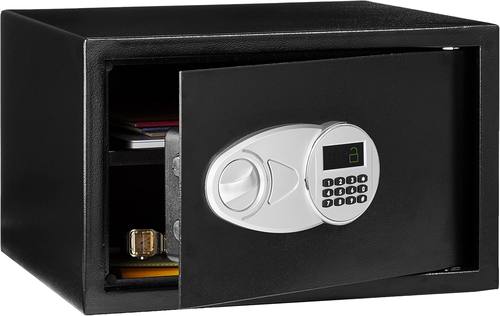 Visit on Amazon →
Best for Documents and Jewelry: Amazon Basics Steel Home Security Electronic Safe
Same 1.2 cubic feet, same programmable keypad, different shape. This one stands 14.2 inches tall on a 13 by 13 inch base, so it is taller than it is wide. That geometry is the reason I put it in its own section instead of folding it into the one above. Upright storage is what you want for hanging file folders, a jewelry box that lives on a shelf, or anything you would rather stack than lay flat.
If you are buying for documents, think about the shape of a document before you think about the size of the safe. Cubic feet is a volume number and volume numbers are honest, but volume does not tell you whether a folder fits upright or has to be folded. Tall and narrow serves paper better. Wide and shallow serves trays and boxes better. Both of these keypad models hold the same volume, and one of them will fit your stuff and the other one will annoy you.
Whichever you choose, anchor it. Bolt it to a floor joist or into a concrete slab with the hardware that comes in the box. An unanchored safe is a carrying case with better manners, and I have seen a 40 pound box walk out of a house in under a minute. 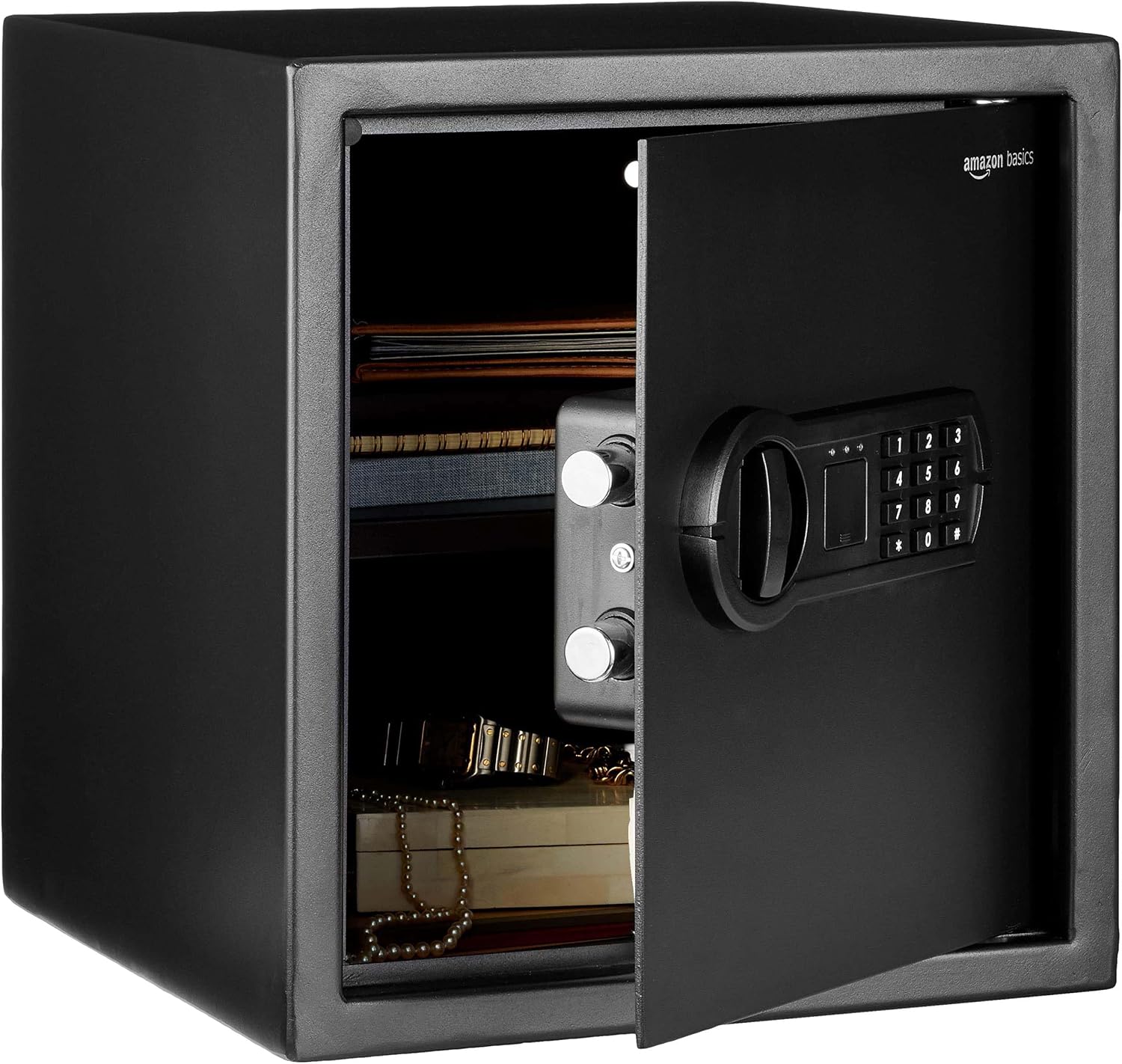 Visit on Amazon →
Best Portable: Amazon Basics Portable Security Case Lock Box with Combination Lock
I am going to be blunt about this category, because I would rather you hear it from me than learn it the hard way. A portable lock box is not a safe. It is a locked container, and the difference is not marketing, it is physics. Anything that can be picked up can be taken to a quiet place and opened at leisure, and no combination lock on a stamped steel case is going to hold up to that.
What it does do is real. It stops the roommate's friend who wanders. It stops the maintenance person with sticky fingers. It keeps your passport, your spare cash, and your external drive out of the top drawer where every burglar starts. In a dorm room or a shared apartment, that is the threat you actually face, and this XL case with a combination lock addresses it with no batteries and no keypad to fail.
The combination lock is the reason I recommend this one for students over anything electronic. Nothing to charge, nothing to die in a drawer over summer break, and no key to lose in a laundry room. Just write the combination down somewhere that is not taped to the box. 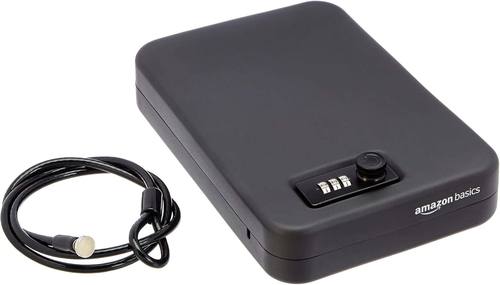 Visit on Amazon →
How I judge a safe
I run every box through the same four questions, and you can run them too from a product page.
First, what is the lock? The lock is the safe. Everything else is sheet metal and paint.
Second, what does the door gap look like? A crowbar wants a gap, and the tighter the gap, the less the bar has to bite on. Pry resistance comes from the gap and the bolt work, not from the thickness of the brochure. The bolts are the metal that actually holds the door shut, and more of them, properly seated, beats a thicker door every time.
Third, how much does it weigh, and can it be anchored? Weight is security. A 20 pound safe is a theft convenience for somebody with a dolly. Bolt it down and the weight stops mattering as much, which is why anchoring is the first thing I ask about.
Fourth, what does the fire rating actually say? A fire rating is minutes at a specific temperature, and it means something only if the test was real. Read the fine print, not the sticker. Any box that says fireproof without a rating is a box that says fireproof because nobody stopped them.
The reference table
| Safe | Best for | Lock | Power | Where it belongs | Price |
|---|---|---|---|---|---|
| Visit on Amazon → Viking Security Safe VS-52BLX Hidden Wall Biometric Safe |
Hidden installation | Biometric with key backup | Batteries | Inside a wall, behind a picture | $347.97 |
| Visit on Amazon → Amazon Basics Steel Security Safe and Lock Box with Digital Keypad |
Flat documents and trays | Programmable digital keypad | Batteries | Closet shelf or floor, anchored | $119.99 |
| Visit on Amazon → Amazon Basics Steel Home Security Electronic Safe with Digital Keypad |
Upright folders and jewelry | Programmable digital keypad | Batteries | Bedroom floor or closet, anchored | $114.99 |
| Visit on Amazon → Amazon Basics Portable Security Case Lock Box Safe with Combination Lock, XL |
Dorms and shared housing | Three wheel combination | None | Wherever you are, then back in the closet | $19.97 |
What the specs actually mean
Cubic feet is the number everybody compares and the number that tells you the least. Two safes can both claim 1.2 cubic feet and hold completely different things, because interior shape decides what fits. The two keypad models here are the proof. One is wide and shallow, one is tall and narrow, and your documents will prefer one of them strongly.
Exterior dimensions are not interior dimensions, and the difference is not small. Walls, a door, bolt work, and a shelf all eat into the space you paid for. If you are measuring a gap in a closet or between studs, measure the outside, and then subtract a couple of inches of breathing room so you can actually get your hand behind the door.
Weight is a spec people read as a durability score, and I read it as a theft score. Heavier is better, but only if it is anchored. If you are not going to bolt it down, buy the heaviest box you can lift into place, and understand that you have bought time rather than security.
Fire ratings deserve their own paragraph because they are the most abused number in this market. A real rating is expressed in minutes at a stated temperature, and it comes from a test. A safe that says fireproof with no rating is a safe with a marketing department. For documents you cannot replace, buy the rating, not the word.
And one more thing about keypads, since it is my standing pet peeve. A keypad that eats batteries in a month is not a feature, it is a maintenance job you did not ask for. Fresh batteries twice a year, a backup key stored outside the safe, and you will never meet me professionally.
Should you buy the Viking wall safe?
Yes, if you have a wall and a willingness to open it. Hiding beats hardening, and a safe nobody can find is a safe nobody can pry. The biometric reader is quick and the build is a step above the shelf boxes. Just treat the battery as a maintenance item, register more than one finger, and keep the mechanical key somewhere that is not the safe itself.
Should you buy the Amazon Basics keypad safes?
Yes, and pick your shape. The wide one with the removable shelf suits flat documents and trays. The tall one suits upright folders and a jewelry box. Both give you a programmable keypad, which is the lock type I recommend to most households because it is the one people will actually use every day.
The honest summary
Buy the safe for the threat you actually face. For most people that is four minutes of a stranger's time, not a professional crew. Hide the box if you can, anchor it no matter what, use a keypad you will actually operate, and read the fire rating's fine print before you trust it with anything irreplaceable. That is the whole game, and it has not changed in 25 years.