Most people buy a fireproof home safe, wrestle it into a closet, set it on the carpet, and call the job finished. Then a house fire or a burglar with a hand truck proves otherwise. Fireproof home safe installation is not complicated, but it is specific. The fire rating only counts when the safe sits the way it was tested, and the lock only counts when nobody can carry the whole box out the front door.
I have been a locksmith in Boise, Idaho for 25 years. I have opened safes that owners swore were impenetrable, plus a few they had simply forgotten the combination to. The pattern is always the same: the box was usually fine, the setup was not. A safe bolted to nothing, sitting in a garage next to a propane tank, with the factory code still in the keypad, is a steel suggestion.
This guide is about the setup. Two safes worth starting with, one workflow, and the caveats that never make it onto the box.
Why you should trust me
I have spent a quarter century opening things people did not want opened. I keep a workshop notebook of which locks fail under which tools, and I run every safe through the same three checks: a pry test with a 24-inch crowbar, a drop test, and a lock manipulation session. I do not write about a safe without a pry test and a lock evaluation, which is why some brands never show up in my writing at all.
I also have opinions you will not hear from a showroom. SentrySafe is the value standard and the fire ratings are real. First Alert safes are fine for documents but the locks are basic, so do not store what you cannot replace. Liberty builds the best mid-range bolt work. Stack-On is budget only, fine for a toolbox and not much else. And nothing in the consumer market is burglar-proof. Anyone who tells you otherwise is selling, not locksmithing.
What I look at before I recommend any safe
Four things, in this order.
The lock. The lock is the safe. A five hundred dollar box with a two dollar lock is a steel box with a suggestion. Digital keypads are the honest middle ground. They are fast, they do not care about wet hands, and they fail predictably. Biometric locks are genuinely quick and occasionally terrifying, and batteries are a single point of failure on any electronic lock, so a key override is not optional.
The fire rating fine print. A rating is minutes at a specific temperature with a specific internal temperature limit, tested in a furnace under a specific curve. A sticker that says "fireproof" with no rating is marketing words. A rating that says 35 minutes at 1,700 degrees means something only if the test was real, so look for the standard the safe was tested to, not the adjective on the front.
The door gap and the bolt work. Pry resistance lives in the gap between the door and the frame and in how many bolts engage the frame. A tight, even gap is half the security. A wide gap with a single bolt is a crowbar invitation.
The weight, loaded. Weight is security. A twenty pound safe is a theft convenience for someone with a dolly. Add the weight of what you put inside, because that is what the thief has to move.
The two safes I would start with
If you want a document safe for a normal house, a mortgage file, passports, birth certificates, and a jewelry box, these are the two shapes of answer. One leans toward capacity and water protection, the other leans toward the temperature number. Read both before you decide.
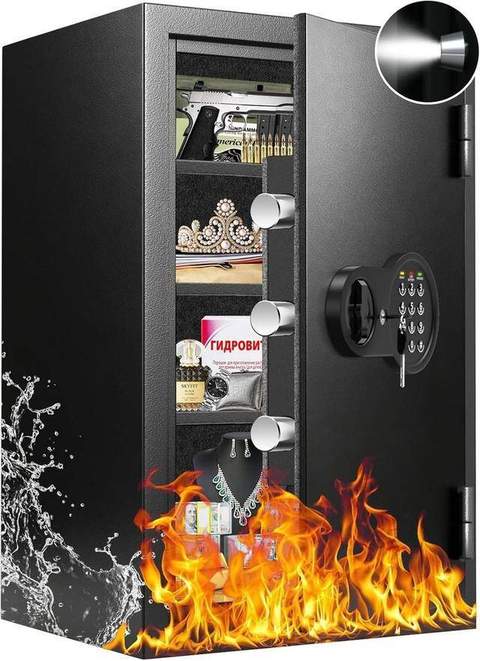
Our pick: Mitlvge 35Min Real Fireproof Safe Box, 23.4'' Tall Home Safes Water and Fireproof with Keys & Pass Code, 3-Removable Shelf and Smart Alert, Fire Proof Safe for Home Document Jewelry Valuables
 Visit on Amazon →
This is the one I would put in a house with a real paper trail. Three things earn it the top slot.
First, it is 23.4 inches tall. That sounds like a spec sheet detail until you try to fit upright folders and a document box into a cube that is only a foot deep inside. Tall interior space means you can file documents instead of stacking them flat, and stacking them flat is how people end up digging through a pile while the smoke alarm is going off.
Second, it carries both a fire rating and a water rating. In a house with a basement sump pump, a second floor laundry, or a fire sprinkler system, water is the damage that arrives without a fire. A safe that stops flames and lets a burst pipe ruin the contents has solved half a problem.
Third, the lock gives you a key and a pass code. That mechanical fallback matters more than buyers think. Keypads die, batteries die at the worst possible hour, and a key that lives somewhere other than taped to the safe is the difference between access and a locksmith bill. The three removable shelves are the quiet win, since you can reconfigure the interior for a jewelry tray, a document stack, or both. The smart alert is a convenience, not a security feature. Treat it as a reminder that the door is open, not as an alarm system.
Flaws but not dealbreakers: A tall safe is a tall object to move. Measure the closet door, the stairwell, and the turn at the top of the landing before it ships, because the delivery driver is not going to help you wrestle it around a corner. And no consumer safe at this level stops a determined professional with time and tools. It stops the smash and grab, which is the threat most houses actually face.
Homeowners who keep real documents and want one safe that covers fire and water should start here.
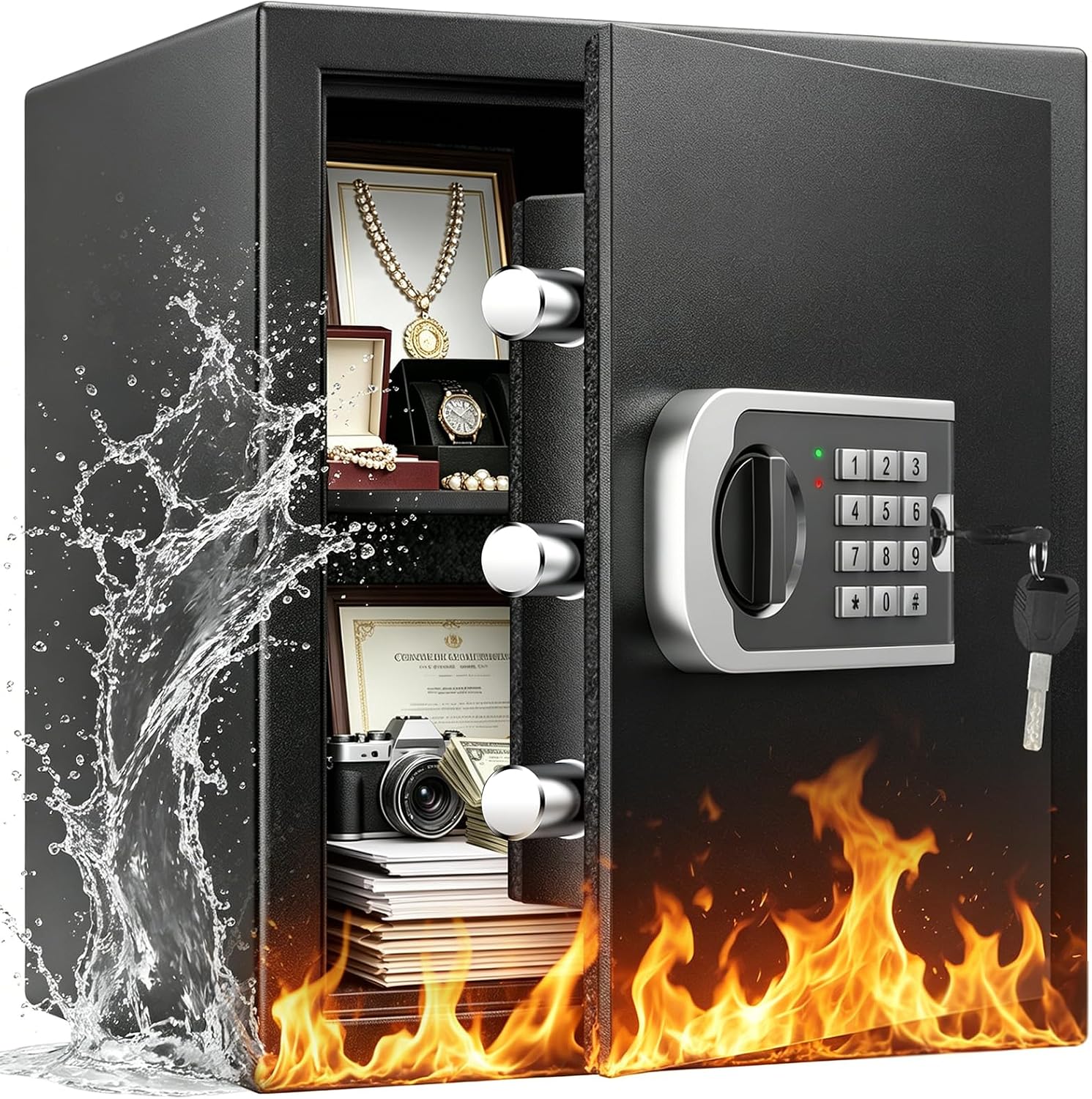
Runner-up: 𝐔𝐩𝐠𝐫𝐚𝐝𝐞𝐝 𝟐𝟎𝟐𝟔 Fireproof Safe 𝟏𝟕𝟎𝟎°𝐅 𝟑𝟓-𝐌𝐢𝐧 Protection
 Visit on Amazon →
Where the Mitlvge leads with water protection and a taller body, this one leads with the temperature figure. A 1,700 degree rating held for 35 minutes is the number a fire safe lives or dies on, and it is the number most shoppers never read past.
Here is the caveat, and it is the important one. That rating is a furnace curve, not a promise that your particular closet will only reach 1,700 degrees. A garage fire with a fuel load behind it burns hotter and longer than a furnace test. A safe in a basement under a collapsing floor gets crushed, and no rating covers crushed. The rating tells you the safe was built and tested to hold an internal temperature low enough to protect paper for a defined window. It does not tell you your house will burn politely.
That makes this the pick for the buyer who wants the temperature and time numbers front and center, and who will actually do the placement work in the steps below. Skip the garage, skip the basement, anchor it, and the rating has a chance to do its job.
Flaws but not dealbreakers: A single headline number is the easiest thing in the world to misread. If you only remember one figure from the box and ignore placement, you have bought a rating instead of a result. Change the factory code the day it arrives, and keep the key somewhere other than the safe itself.
Renters and apartment dwellers who need a document safe and cannot drill a floor should look at this one first, then read the anchoring compromise below.
The setup, step by step
Step one: choose the room before you choose the spot. Ground floor, interior wall, away from the furnace, the water heater, and the garage. The garage is where the gasoline, the propane, and the lawn chemicals live, and it is the first room to burn hot. Basements flood. Second floor closets end up in the basement anyway if the floor goes.
Step two: get it off bare concrete. Concrete wicks moisture, and a safe sitting flat on a slab in a damp basement rusts from the bottom up. A plywood pad or a sturdy shelf solves it. Keep an inch of air behind the safe if the wall is exterior.
Step three: anchor it, for real. Bolt through the bottom into a floor joist or a concrete slab, or through the back into two wall studs with lag bolts and washers. Four anchor points if the safe gives you four holes. If you rent and cannot drill the floor, a back wall anchor into studs is the honest compromise, and a tube of spackle makes it a non-event at move-out.
Step four: level the door. Shim the base until the door swings free and the gap is even all the way around. A door that drags means a twisted frame, and a twisted frame opens the corner gap that a pry bar wants to find.
Step five: set the lock before anything goes inside. Change the factory pass code. Test the key. Do not write the code on the safe, on the wall behind it, or on the inside of the closet door. Do not store the key in the same room.
Step six: load it with the door in mind. Documents upright if the interior allows it, in a fire bag if you have one. Do not overstuff to the point where the door needs a hip check to close. A door that does not seat fully has no fire rating at all.
Step seven: photograph everything and store the list off site. Pictures of each document, the serial number of the safe, and the model number, emailed to yourself. That file is what your insurance company will ask for.
Step eight: know what to do after a fire. Do not open the safe the moment the flames are out. Heat soaked into the walls keeps the interior hot long after the fire is out, and contents that finally meet fresh air can ignite. Manufacturers tell you to wait. Wait.
Mistakes that cost you the protection
Buying the adjective instead of the rating. "Fireproof" with no tested standard behind it is a word, not a result.
Trusting a keypad with no key. Batteries die, and a keypad that eats batteries in a month is a monthly reminder that you have no backup.
Storing what you cannot replace. A passport can be reissued. The only photograph of your grandmother cannot. If it is truly irreplaceable, keep a copy somewhere else too, because no safe is a guarantee.
Hiding it in the master bedroom closet and calling that clever. That is the first place a burglar looks. A hall closet or a home office is a better bet.
Skipping the anchor because the safe feels heavy. It feels heavy to you. It feels like a two person job to a thief with a dolly and thirty seconds.
What this all costs
Check current Amazon price on both safes and compare them against your actual document load, not against the biggest box you can afford. Anchoring hardware is a hardware store purchase, a handful of lag bolts, washers, and a concrete anchor kit if you are drilling a slab. The rest of the cost is one afternoon and a tape measure.
Over the life of the safe, the anchoring hardware costs less per day than the coffee you drink while you install it, and it is the single step that separates a safe from a heavy box.
The bottom line
The lock is the safe, the rating is measured rather than imagined, and the anchor is what keeps either of them relevant. Pick the interior that fits your documents, put it on an interior wall on the ground floor, bolt it down, change the code, and photograph what goes inside. That is the whole job.
Your safe was built to do this. Give it a chance to.