Related: How Fire Ratings Are Actually Measured
A fireproof home safe is three products in one box: a lock, a container, and a promise. Most shoppers compare the promise, because the promise is the part the packaging shouts at you. I compare the lock and the door gap, because that is the part a thief meets first.
I have worked as a locksmith in Boise, Idaho for twenty-five years. I have opened safes for owners who swore theirs could not be opened, and I have opened a few with tools that cost less than dinner for two. When I write about a safe, I write about the four things I can actually check: the lock, the door gap, the bolt work, and the fine print behind the fire rating.
The four safes here cover what most households are really shopping for. There is a 2.8 cu ft document box with a fireproof bag, a 5.2 cu ft cabinet with removable shelves, a 23.4 inch tall unit that states a real minute rating, and a mini biometric box for the handful of things you want in five seconds. None of them is burglar-proof. Nothing sold to a homeowner is. The question is which one matches the threat you actually face, and for most people that is a smash-and-grab, not a crew that showed up with a truck.
Best Fire Protection: Mitlvge 35Min Real Fireproof Safe Box
This is the safe I would put in a closet if paper were the priority. The listing states a 35-minute fire rating, and that word "minute" matters more than the word "fireproof." Fire ratings are measured, not imagined. A rating means minutes at a stated temperature, so a listing that gives you minutes is telling you more than a listing that gives you a sticker.
The rest of the package is sensible. It stands 23.4 inches tall, it has three removable shelves, it opens by key or pass code, and it adds a smart alert. Two entry methods is the honest middle ground. A key is what you reach for when the keypad battery is dead, and it will be dead at the worst possible moment, because that is when batteries die.
Water protection is listed alongside fire, which is the part people forget. The fire department puts out the fire with thousands of gallons of water. A safe that keeps out heat but lets in water still hands you a brick of pulp.
What I cannot tell you from a listing is whether the door gap is tight or whether the bolt work is worth the powder coating. That is a pry test question, and I get to it below.
Best Value for Documents: [16.54" Tall] Safe Box, 2.8 Cuft
This is the small-footprint option, and the included fireproof bag is the part I like. A bag inside a safe is a second layer, and it is the layer that travels if you have to grab something and leave. Bags are rated for paper, not for jewelry and not for drives, so use it for what it was built to hold.
At 16.54 inches tall, this box is short. That is not a flaw, it is a placement decision. It goes on a closet shelf, which keeps it out of sight, which is half of what you are buying. A safe in plain view with a shiny keypad is an invitation. A safe behind a stack of towels is a chore.
The lock is standard consumer fare: a keypad with a key backup. That is the honest middle ground for most homes, fast enough to use daily and slow enough that a curious kid does not get in. What I would watch is the door gap. On small boxes at this price point, the gap between door and body is where a pry tool goes to work, and a bag inside will not help you there.
Anchor it, or do not bother. A small box is the easiest thing in the house to carry out the front door.
Biggest Capacity: 5.2 Cuft Large Home Safe
At 5.2 cu ft, this stops being a box and starts being a cabinet. Three removable shelves, a keypad, a key, and a fireproof waterproof bag in the box. Pull the shelves and you have one tall cavity for binders, boxed files, jewelry trays, and the bag itself.
Capacity is where people overbuy or underbuy. Underbuy and you leave the important half of your paperwork in a shoebox on the top shelf. Overbuy and you spend money on air. Measure what you actually keep, not what you feel guilty about keeping. A standard banker's box is roughly a cubic foot, so 5.2 cu ft is about five of them before shelf hardware and the bag eat into the space.
The anti-theft language in the listing is normal marketing, and it is not a rating. What matters is bolting. A safe this size on a closet floor, bolted through the bottom into a joist, is a real obstacle. The same safe loose on carpet is a dolly job for anyone with five spare minutes.
Best for Fast Access: Viking Security Safe VS-20BLX Mini Biometric Safe
Biometric locks are convenient and occasionally terrifying. When the reader works, it is faster than any keypad and far faster than a dial. When your hands are wet, cold, or shaking, it is a locked box with a fingerprint smeared on it. The battery is a single point of failure, and a mini safe does not leave much room for a spare set.
Mini means mini. This is a passport, a few documents, a ring, some cash, and a spare key to something else. It is not a document safe. If your goal is a stack of file folders, buy one of the three boxes above and leave this one on the shelf.
Where this safe earns its place is the drawer role: the thing you open twice a day, not twice a year. Keep the override key somewhere other than the safe, and test the reader once a month with dry hands and once with damp hands. If it starts asking for two or three swipes, change the battery before it starts asking for none.
How I tested
Every safe that comes through my shop gets the same treatment. I start with the door gap, because that is where a pry attack begins. A 24-inch crowbar is the honest test. If I can get the tip into the gap and move the door, the safe has a problem, and I do not need to be gentle to find it.
Then the drop test. Doors, bolts, and hinges get tested by gravity, usually during a move or a break-in. A safe that pops open when it lands on a corner was never a safe.
Then the lock. Digital keypads get probed for weak defaults and reset tricks. Biometric readers get tested with dry, damp, and dirty fingers. Mechanical dials get the slow treatment, because a dial you open forty times a year is a dial you will learn to resent.
Fire ratings get the fine-print treatment. I want minutes and a temperature. If a listing gives neither, I treat "fireproof" as a marketing word rather than a rating. A fireproof bag is a different product from a fireproof safe, and it protects a different amount of paper for a different amount of time.
One more boundary: I do not test gun safes. That is a different liability lane and a different conversation.
Analysis: locks, gaps, and the fine print
There are three lock types in this group, and each one trades something away. A mechanical dial is the most reliable mechanism in the box and the slowest to use. A digital keypad is the honest middle ground, quick enough to live with, and its failure point is a battery you can replace. A biometric reader is the fastest when conditions are perfect and the most fragile when they are not.
Door gap and bolt work are where the money actually goes. Pry resistance comes from a tight gap and bolts that reach into the frame on more than one side. A thick door with a wide gap is a thick door with a handle on it. Brochure thickness tells you almost nothing about either.
Fire ratings are minutes at a temperature. A 35-minute claim is more useful than the word "fireproof," but you still want the temperature. Paper chars somewhere around 400 degrees Fahrenheit, and it does not need open flame to be destroyed. Heat alone does it, which is why a box that survived the flames can still hand you ash.
Weight is security. A 20-pound safe is a theft convenience for anyone with a dolly, and a safe you cannot move alone is a safe that stays where you put it. Bolt it anyway. Interior wall, out of sight, off a concrete floor in flood country, and away from an exterior wall that bakes in the afternoon sun.
Home safe reference table
The same four safes, one line each, using only what the listings state. This is the version I keep on the bench when the phone rings.
| Safe | Lock | Fire protection stated | Size and storage | Best for |
|---|---|---|---|---|
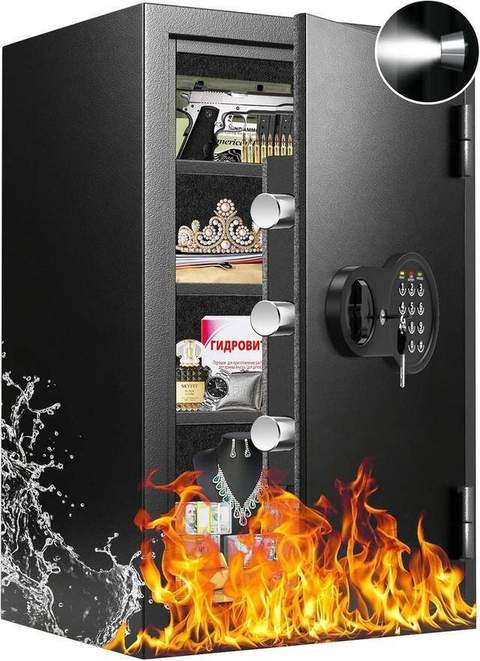 Visit on Amazon → Visit on Amazon →Mitlvge 35Min Real Fireproof Safe Box |
Keys and pass code | Stated 35-minute fire rating, water protection listed | 23.4 inches tall, 3 removable shelves | Documents and valuables where fire is the main worry |
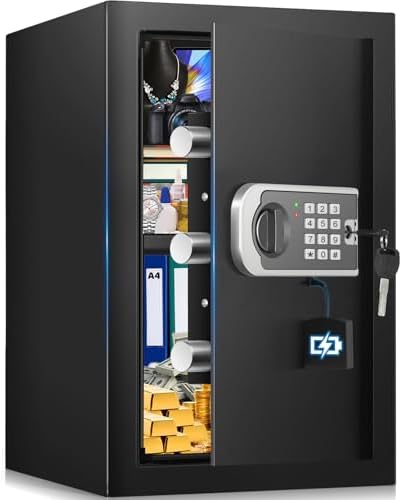 Visit on Amazon → Visit on Amazon →16.54" Tall Safe Box, 2.8 Cuft |
Keypad with key backup | Fireproof bag included, no minute rating stated | 2.8 cu ft, 16.54 inches tall | A closet-shelf document box on a budget |
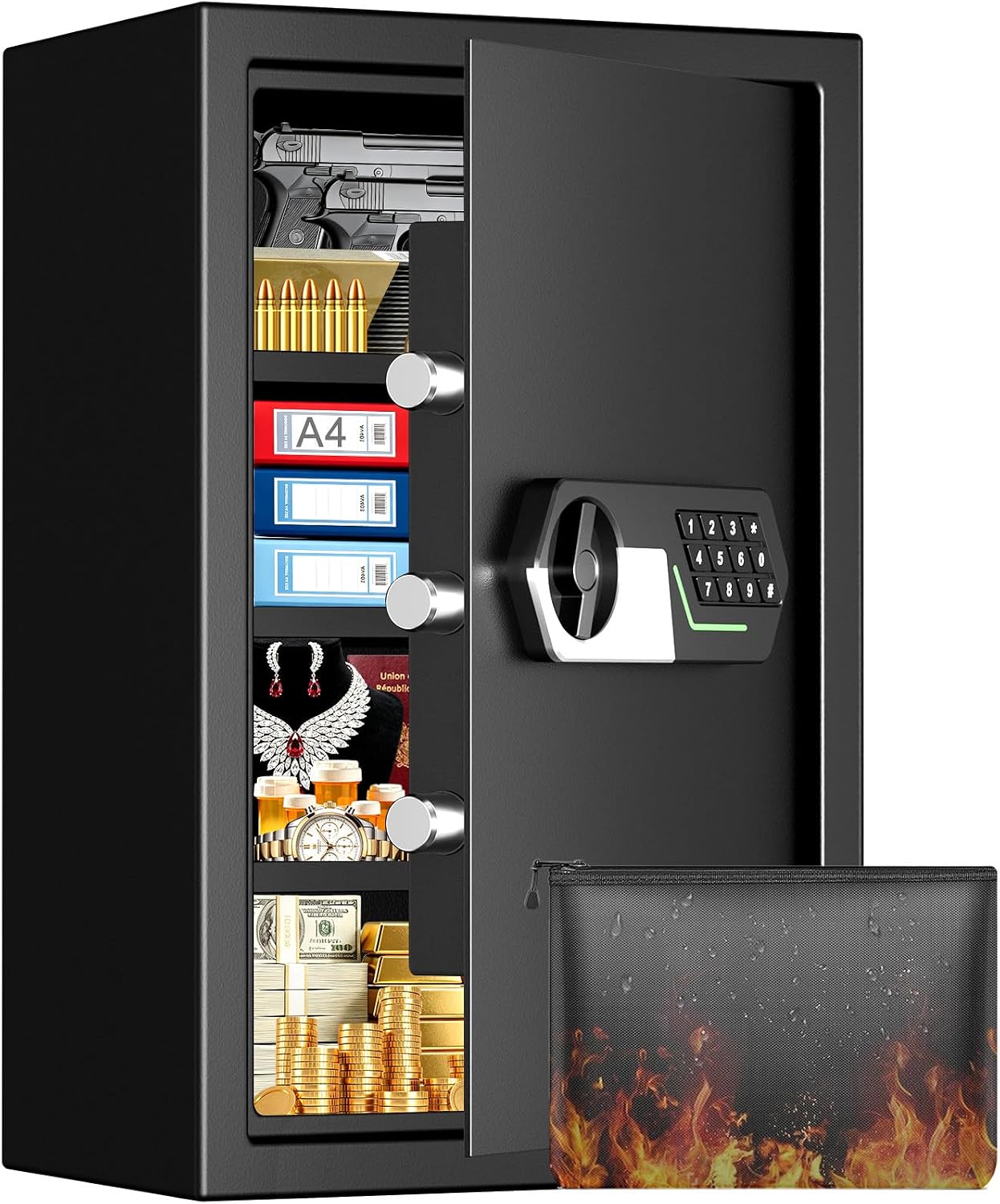 Visit on Amazon → Visit on Amazon →5.2 Cuft Large Home Safe |
Keypad and key | Fireproof waterproof bag included, no minute rating stated | 5.2 cu ft, 3 removable shelves | Households with more paper than a folder |
 Visit on Amazon → Visit on Amazon →Viking Security Safe VS-20BLX Mini Biometric Safe |
Biometric | No fire rating stated in the listing | Mini footprint | Daily access to a few small items |
Should you buy the Mitlvge 35Min Real Fireproof Safe Box?
If paper is the priority, this is where I would start. It is the only safe in the group that states a real minute rating, it lists water protection alongside fire, and it gives you two ways in. Verify the fine print behind the rating, then bolt it down. A safe with a good rating and a loose door gap is a safe with one good feature.
Should you buy the 16.54" Tall Safe Box?
Yes, if your list is documents and you want the smallest footprint in the house. The included bag is a genuine second layer, and the short height makes it easy to hide on a shelf. Understand what you are buying: a basic keypad lock and a box, not a rated container.
Should you buy the 5.2 Cuft Large Home Safe?
Yes, if you have more than a folder to protect. This is the volume play, and volume is the thing you cannot add later. Pull the shelves, load it, and bolt it through the bottom. Buy it for the space, not for the marketing language on the listing.
Should you buy the Viking VS-20BLX Mini Biometric Safe?
Yes, if you want a small box you open every day and you accept the battery risk. No, if you are protecting a stack of documents. This is a fast-access box, not a fire safe, and the listing makes no fire claim for it.
The bottom line
Buy the safe for the threat you actually face. Most households face a smash-and-grab, and the answer to that is a bolted box with a tight door gap and enough weight to stay put. Match the lock to your patience, match the fire rating to what you are storing, and treat every bag as a layer rather than a rating. Check current Amazon price on all four before you decide, and bolt whatever you buy.