Most people buy a safe the way they buy a mattress. By the pound, by the price tag, in a hurry, with no real idea what is inside the box. Then it goes in the master bedroom closet, the code gets set to something with a birthday in it, and that is the end of the thinking.
Knowing how to choose a home safe is really four questions, and none of them appear on the front of the box. What is the lock? Can I get a crowbar into the door gap? What does the fire rating actually say in the fine print? And would I trust it with something I cannot replace?
I have been a locksmith in Boise for 25 years. I have opened safes the owners swore were impenetrable, and I have opened safes the owners did not know were broken. The good news is that for most households the threat is a smash-and-grab, not a crew with cutting tools. That is a threat a decent safe, bolted down, defeats outright.
Why you should trust me
Twenty-five years behind a van and a bench means I have seen the inside of more safes than most salespeople have seen the outside of. Every safe that comes through my shop gets the same treatment: a pry test with a 24-inch crowbar, a drop test, and a lock manipulation session until I either get in or give up and admit the thing is built right.
I keep a workshop notebook of which locks fail under which tools. It is not a glamorous document, but it is honest, and it is the reason I do not repeat marketing language. I have no interest in telling you a box is burglar-proof. Nothing is burglar-proof. What I can tell you is which boxes make a thief move on to an easier house, and that is a much more useful standard.
How I judge a safe before I recommend one
Four checks, in order. Skip any of them and you are buying a steel cabinet, not a safe.
The lock. The lock is the safe. A heavy box with a cheap lock is a steel box with a suggestion. Digital keypads are the honest middle ground for a home: fast, easy for a spouse or an adult kid to use, and not dependent on the condition of your fingertip. Mechanical dials are more reliable over decades and slower every single day. Biometric readers are genuinely fast and genuinely a single point of failure. A dead battery at 11 p.m. is not a security feature.
The door gap. Pry resistance comes from the door gap and the bolt work, not the thickness of the brochure. Take a flashlight to the seam where the door meets the body. If you can see a lip of daylight wide enough for a pry bar to bite, that is the opening a crowbar wants to find. A tight gap is half the security, and it costs the manufacturer real money to build.
The fire rating. Fire ratings are measured, not imagined. A one-hour rating at 1,550 degrees means something only if the test was real and the rating is stated clearly. If the packaging says "fireproof" with no minutes and no temperature, you are reading a sticker, not a rating.
The contents test. Would I trust it with someone's irreplaceable documents? That is the only question that matters at the end. A passport you can replace. A deed, a will, a title, a folder of photographs from a parent who has passed, those are the items that decide how much safe you actually need.
The safe for the house documents
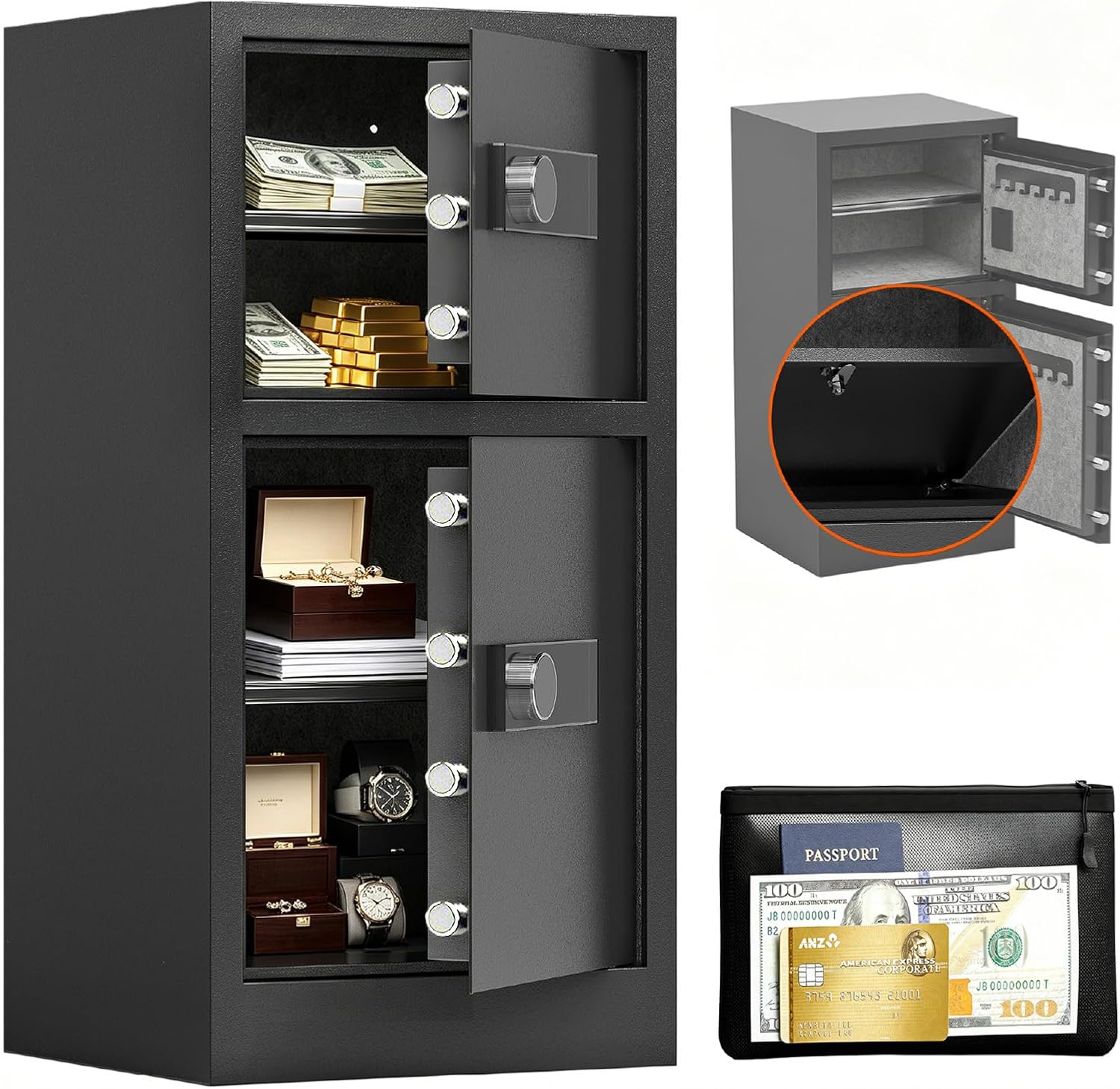
The main safe: Xyvaly Safe 8.6 Cu Ft Extra Large Safe for Home with Fireproof Waterproof Bag,Heavy Duty Double Door Security Safe Box,Digital Safes,Removable Shelves,Hidden Lock Box for Cash Files Office Document
 Visit on Amazon →
This is the one I would point at a household that keeps a decade of paperwork, a few binders, and a shoebox of things that never found a home. The name tells you the shape of it: 8.6 cubic feet, double door, digital keypad, removable shelves, plus a fireproof and waterproof bag and an inner lock box. That capacity number matters more than people expect, because a safe you cannot organize is a safe you stop using, and a safe you stop using is a safe with the door standing open.
The digital keypad is the part I would defend to any locksmith who swears by a dial. It is quick, it is legible, and it does not care whether your hands are full. The trade is the same as every electronic lock ever made: it eats batteries, and when it dies you had better know where the override key is. Put that key somewhere outside the house. Not taped to the back of the safe, not in the drawer beside it, and not in the little bag of documents inside it.
The double door layout is genuinely useful for organization. The outer compartment handles the things you touch a few times a year, and the inner section holds the documents that should only come out when you are moving or updating them. The removable shelves mean you can reconfigure as your pile of paper grows, which it will.
Flaws but not dealbreakers: This is a large safe, and large means visible. Sitting on a closet floor unbolted, it is a dolly job for two people, and everything in it leaves with them. Anchor it or do not buy it. Also treat the keypad like any electronic lock: change the battery on a schedule, not when it starts beeping at you.
Homeowners with a real document problem and a slab or floor joist to anchor into will get the most out of this one.
The safe that leaves the house
The grab-and-go pick: Diyife Portable Safe Box, [Waterproof] Travel Safe Lock Box with Code
![Diyife Portable Safe Box, [Waterproof] Travel Safe Lock Box with Code](/images/products/B0F7XPKSG9.jpg) Visit on Amazon →
Visit on Amazon →
A portable box is not a home safe, and I want to be straight about that before anyone buys it expecting one. It is a code-locked, waterproof box for the things you cannot leave loose in a hotel drawer, a rental kitchen, a dorm room, or a car trunk on a road trip. Passport, spare cash, a card you do not want on your person, a set of keys.
The code lock is convenience, not a vault. It stops the casual hand, the roommate's guest, the housekeeper who is having a bad month. It does not stop anyone who decides to take the whole box, which is why the size is the point: it goes with you, or it goes into something heavier. One pattern I like is keeping it inside the big safe between trips and pulling it out when you travel, so the travel documents live in one place and the rest of the year they are behind a real door.
Flaws but not dealbreakers: Light and portable is the feature and the weakness in the same sentence. Anything you can carry, someone else can carry. Set a code you have not used anywhere else, and remember that a four-digit code you can remember at 6 a.m. in an airport is worth more than a clever one you cannot.
Travelers, renters, and anyone living in a shared building will get real use out of this. Anyone expecting it to protect heirlooms should keep reading the section above.
The actual setup workflow
Now the part that matters. A safe is a system: the box, the location, the anchor, and the habits around it. Get the last two wrong and the first two do not matter.
Step one: Pick the lock type first. Digital keypad for daily use, mechanical dial if you want a lock that will still work when you are 80, biometric only if you accept a battery as a failure point. Whatever you pick, test it twenty times before you commit anything valuable to the inside.
Step two: Size it to the contents, not the closet. Stack the actual folders, binders, and boxes on the floor and measure the pile. Most people overbuy the height and underbuy the depth. If you are between two sizes, go up one, because a safe that is full to the ceiling is a safe with the door open.
Step three: Choose the location like an adult. The master bedroom closet is the first place anyone looks. A basement corner on a concrete slab, a first-floor closet with a floor joist under it, or a garage wall against a stud beats a bedroom every time. Heavy, hidden, and anchored is the whole formula.
Step four: Bolt it down. This is the step people skip and it is the step that counts. Weight is security, and a 20-pound box is a theft convenience for someone with a dolly. Anchor into concrete with the appropriate masonry hardware, or through the floor into a joist, or into a wall stud if the floor is not yours to drill. If you rent, anchor into the stud and accept a drywall repair when you leave.
Step five: Check the door gap once it is in place. With the door shut, run a flashlight along the seam. If you find a gap that takes a pry bar tip, that is your weak point, and the fix is usually a tighter install, a backer, or a different safe. Do not ignore it because the box is heavy.
Step six: Set the code and store the override somewhere else. Change the factory code the day it arrives. Do not use a birthday, an address, or the last four of anything. The override key goes to a trusted relative, a safe deposit box, or a locked drawer in a different building. Somewhere that is not the house the safe is in.
Step seven: Use the waterproof bag for the paper that matters. Water does more document damage than flame in a lot of house fires, between the hoses and the sprinklers. The bag that comes with the larger safe is not decoration. Deeds, titles, passports, and the insurance policy go inside the bag, inside the safe, in that order.
Step eight: Decide what does not belong. Nothing you need daily. Nothing you would need to grab in a fire at 2 a.m. And nothing you cannot afford to lose the key to. The safe is for the things you touch twice a year, not the things you touch twice a week.
Step nine: Maintain it on a schedule. Battery change on a calendar date, not on a beep. Open and close the door once a month so the mechanism does not sit. Test the keypad every time you come back from a trip, before you need it under pressure.
The competition and why it lost
SentrySafe is the value standard, and I will say that plainly. The SFW123GDC is the best-selling safe in America for a reason, and the fire ratings are real rather than decorative. If you want a proven, mid-size document safe and you do not want to think hard about it, that family of products is not a mistake.
First Alert's safes are fine for documents, but the locks are basic. Buy one for paper you can replace. Do not store what you cannot.
Liberty Safe builds the best mid-range safes on the market, and the bolt work and door gap are a cut above the mass-market brands. They are also made in the USA, which matters to a lot of people shopping at this price level. If you are buying a safe as a fixture for the next twenty years, that is where the money goes.
Vaultek's biometric boxes are genuinely fast and the build quality is excellent, but a battery is a single point of failure and I will not pretend otherwise. Great for a nightstand. Think hard before you make it the only lock on the family documents.
Stack-On is budget-only. Fine for a toolbox, not for anything you would cry about losing. And gun safes are a different conversation with a different set of rules. That is not this article.
What this all costs
The safes themselves vary from portable to floor-standing, so check current Amazon price on each before you commit. The rest of the budget is small and it is where the security actually lives.
- Anchor hardware: a handful of bolts and washers, or a masonry kit. Cheap, and it is the difference between a safe and a box.
- Batteries: a two-pack of whatever the keypad takes, once or twice a year. Buy them ahead of the beep.
- The override key: free, if you actually put it somewhere sensible.
- The hour of labor: yours, on a Saturday, with a drill and a level.
A safe that is bolted, coded properly, and loaded with the right documents is doing its job every day of the year for pennies. A safe that is not bolted is a gift to whoever breaks in, because now they have a carrying case. That is the whole decision, and it was never about the brochure.
That is the job. The box is the easy part.