Most people buy a safe, drop it in a closet, and call it done. Fireproof home office safe setup is not a hardware problem. It is a sequence problem, and the order you do things in decides whether your documents survive the night something goes wrong.
I have been a locksmith in Boise for 25 years. I have opened more safes than the manufacturers would like to admit, including a few the owners swore were impenetrable. What I have learned is that the safe is rarely the weak point. The installation is. A safe bolted to nothing, loaded with the wrong things, with a lock nobody has tested since the day it shipped, is a steel box with a suggestion of security.
This guide walks through the two safes most households actually need, where each one belongs, and the order to set them up in so you are not locked out of your own documents on the worst day of your year.
Why you should trust me
I have been in the trade since the 1990s, and I have yet to meet a consumer safe that a determined person with the right tools and an hour alone cannot defeat. That is not a sales pitch. It is the reason I evaluate every safe the same way: a 24-inch crowbar pry test on the door gap, a drop test, and a lock manipulation session. I keep a workshop notebook of which locks fail under which tools, and that notebook is why I do not use the word burglar-proof and why I will tell you plainly when a container is a decoy.
I do not recommend a safe for a role it cannot fill. If you want a container, buy a container. If you want misdirection, buy misdirection and be honest with yourself about which one you bought.
How I judge a safe before it earns a spot in a house
Four questions, in order:
- What is the lock? The lock is the safe. A body with a cheap lock is a steel box with a suggestion.
- Can I pry the door gap? Pry resistance comes from the gap and the bolt work, not from the thickness printed on the brochure.
- What does the fire rating actually say? Minutes at a specific temperature. Read the fine print, not the sticker.
- Would I trust it with someone's irreplaceable documents?
Both safes below have a clear role in a home. One is a container. One is a decoy. Confusing the two is how people lose things they cannot replace.
The two roles a home safe plays
Every household I work with ends up needing two things: a real safe for documents and valuables that would be a genuine loss, and a decoy for the cash and small items a smash-and-grab thief is hunting. The decoy exists so the thief takes something and leaves, instead of spending twenty minutes tearing your closet apart.
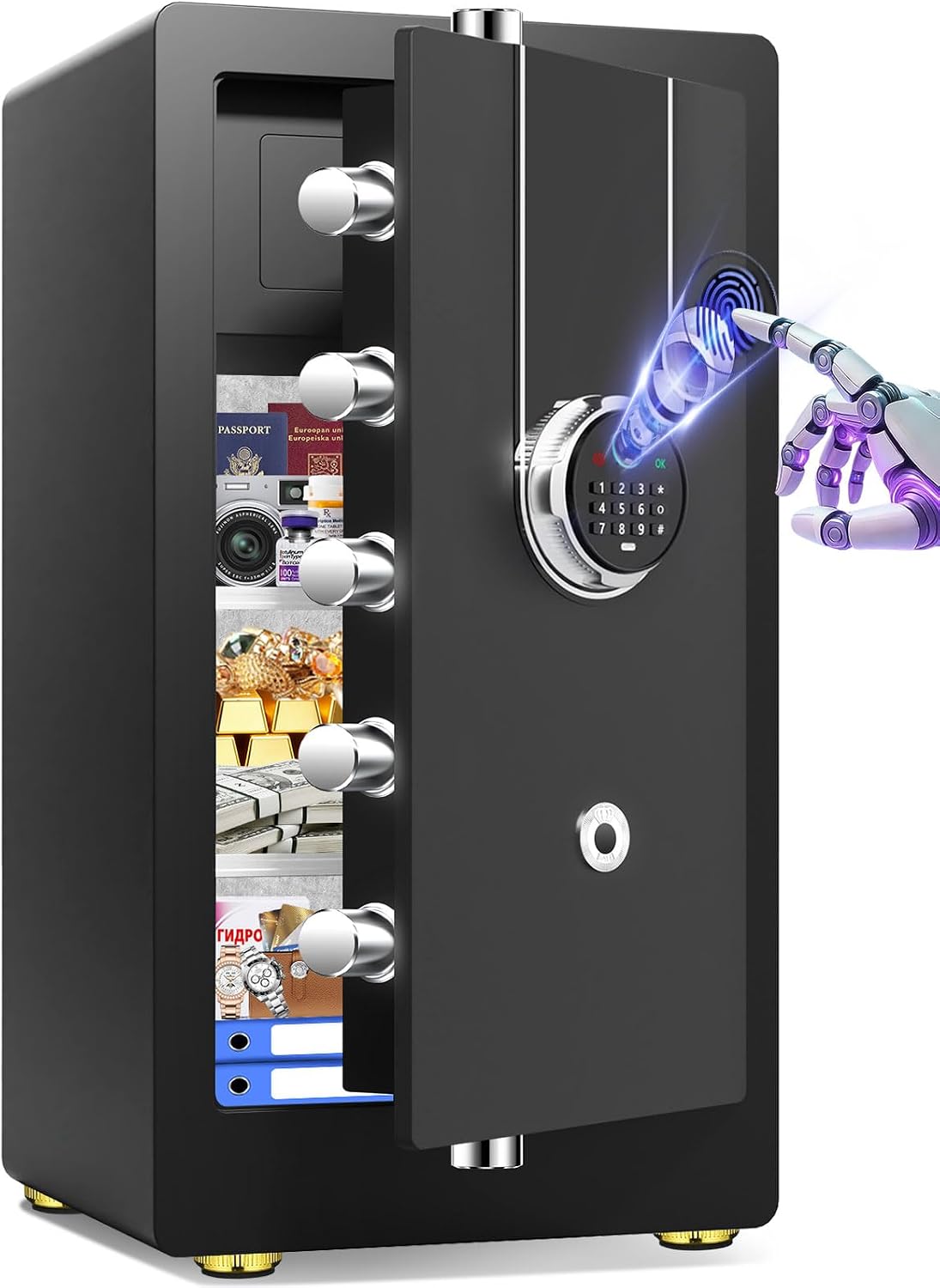
The primary container: 8.2 Cu Ft Fireproof Biometric Safe for Home Office
 Visit on Amazon →
8.2 cubic feet is a real capacity, not a shoebox with a lock on it. That is enough for a document binder, a laptop, a jewelry case, and the folder of titles and policies most people currently keep in a plastic tub under a bed. Check current Amazon price.
Biometric access is the reason to pick this one for a home office. In a workspace you are in and out of the safe constantly, and a fingerprint read beats spinning a dial when you are holding a cup of coffee. Biometrics are convenient and occasionally terrifying, and the caveat is the same one I give every client: batteries are a single point of failure. Set the keypad code and locate the backup key before you trust the sensor, and keep the backup credential somewhere outside the safe.
Flaws but not dealbreakers: A biometric sensor is one more component that can fail, and a big interior volume invites you to fill it with things that do not belong in a fire safe. Keep paper and electronics in it. Keep the things you need to grab in a hurry somewhere else.
Households with a home office, real documents, and a need for fast access are the right buyers for this one.
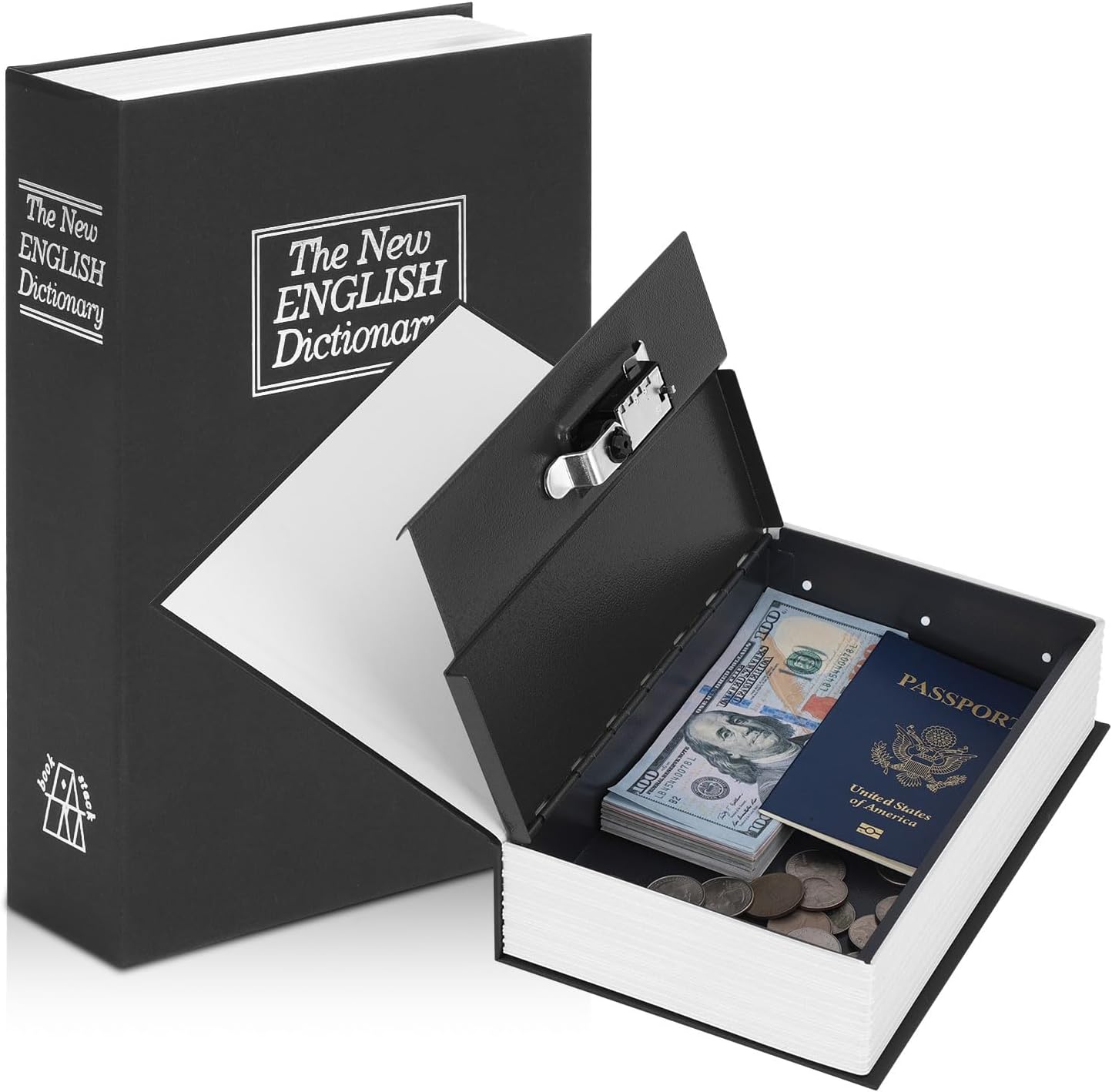
The decoy: KYODOLED Diversion Book Safe with Combination Lock, Secret Safe Metal Lock Box, Money Storage Collection Box, 9.5" x 6.2" x 2.2" Black Large
 Visit on Amazon →
A diversion safe is not security. It is misdirection, and misdirection has a real job: it hands a quick thief a win so he stops looking. This one is a metal lock box inside a book-shaped shell, sized at 9.5 by 6.2 by 2.2 inches, with a combination lock. Check current Amazon price.
The combination on a box like this is a deterrent, not a vault. Anyone determined and unhurried will get into it. That is fine, because nothing valuable goes inside. This is where the emergency cash lives, along with the spare key to the shed and a passport photocopy. If a thief walks off with it, you are annoyed, not ruined.
Flaws but not dealbreakers: It looks like a book on a shelf, which means it needs to sit among real books with a similar spine height. Put it on a bare shelf in a home office and it reads as exactly what it is.
Renters, and anyone who wants a cheap second layer of misdirection, should start here.
Placement: where the safe actually goes
Placement is half the install. These are the rules I hand clients before they drill anything.
- Not the master bedroom closet. It is the first place a burglar checks and often the first place a fire reaches.
- Ground floor or basement, on a concrete slab if you have one. A slab gives you something real to bolt into.
- Out of sight from any window or door glass. If a person on the sidewalk can see it, move it.
- Not the garage. Garage fires burn hot and fast, and a fire rating is measured under specific conditions, not the conditions of a garage full of solvents.
- Not directly under a bathroom or a water heater. Fire and water are both on the list of things that ruin paper.
Weight is security, but anchoring beats weight. A light safe is a theft convenience for someone with a dolly, and an anchored light safe is harder to take than a heavy loose one.
The order of operations
Do these in sequence. The sequence is the point.
Step one: Anchor the empty safe first. An empty safe is lighter and easier to position. Use the mounting holes the safe provides, drill into the slab or through the floor into a joist, and set the hardware so the door still swings clear. If you rent, a plywood backer bolted to a wall with the safe bolted to the backer is a compromise, and you should know it is a compromise.
Step two: Set the backup credential before the primary one. On the biometric safe, program the keypad code first. Then put the backup key somewhere outside the safe, somewhere you will remember during a fire at 2 a.m. Only then enroll a fingerprint.
Step three: Enroll two fingers per person, in the position you actually use. Most failed reads I see are angle problems, not sensor problems. Enroll the index finger of each hand while standing where you will be standing when you open the safe.
Step four: Run the lock through a full cycle test with the door open. Ten open and close cycles. Do this before you load anything, so a bad read does not strand your documents inside a locked box while you hunt for a locksmith.
Step five: Deal with humidity. Paper and moisture are enemies. If your climate swings, a desiccant pack inside the safe and a check twice a year is cheap insurance. Do not store photographs loose against the lining. Put them in an archival sleeve or a sealed bag.
Step six: Stage the decoy. Match the book safe to the shelf it lives on. Same spine height, same shelf depth, surrounded by real books. A decoy on an empty shelf is a sign that says look here.
Step seven: Photograph everything you put inside. Your insurance claim will be built from a list, not from the contents of a safe that is now a puddle of steel and ash. Photograph the documents, the serial numbers, the jewelry, and store the photos somewhere off site.
Step eight: Put maintenance on the calendar. Test the lock monthly. Change the batteries on a schedule instead of waiting for the low battery chirp, because the chirp always starts at the worst possible time. Wipe the sensor with a dry cloth. Check the desiccant.
What goes in which safe
In the primary container: birth certificates, passports, deeds and titles, insurance policies, backup drives, the jewelry you do not wear daily, and anything a bank or a notary will ask you to produce.
In the decoy: cash you can afford to lose, a spare key, a photocopy of a passport, and nothing you would have to replace through a government office.
Somewhere else entirely: the things you need to carry out of the house during a fire. A safe protects documents from heat. It does not help you when you are standing at a shelter. Keep the go bag separate and keep it light.
Mistakes I see most
- Buying on weight rating and ignoring what the contents weigh. A safe rated for the box is not rated for a hundred pounds of coins.
- Trusting the word fireproof without a rating. A rating is minutes at a temperature. If the box does not state one, treat it as a lock box, not a fire safe.
- Never testing the lock until the day it matters.
- Telling the neighbor, the contractor, and the dog walker about the decoy. Its entire value is that nobody knows.
- Loading a safe before it is anchored, then deciding anchoring is too much work.
What this all costs
The primary safe is the real purchase. The decoy is the rounding error next to it, and the consumables are batteries and a desiccant pack, which run a few dollars a year. Both the biometric safe and the book safe move around in price, so check before you buy. Check current Amazon price.
What you are really paying for is the order of operations above. A safe that is anchored, tested, and loaded with the right documents is worth more than a bigger safe sitting loose in a closet. Do the setup once, put the maintenance on a calendar, and the safe disappears into the background of your house, which is exactly where it belongs.
That is the job. Anchor it, test it, then fill it.