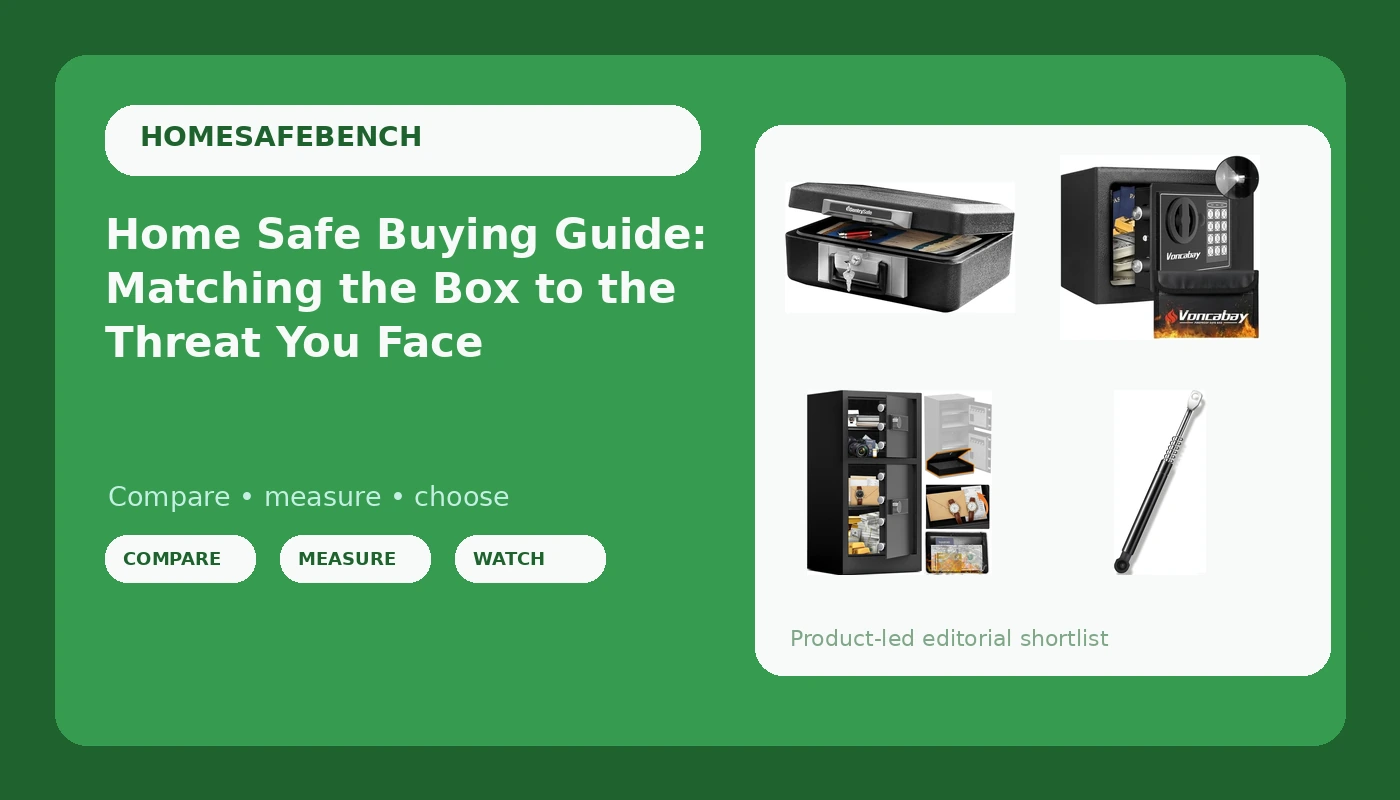
A home safe buying guide usually opens with a size chart and a budget line. That order is backwards. What you need is defined by two questions: what are you protecting, and who is realistically going to try to take it? A smash-and-grab burglar with a crowbar and ninety seconds is one problem. A house fire is a different problem. A curious teenager with an afternoon to kill is a third. The four products below cover the range most households actually land on: a key-locked document chest, a digital keypad box for cash and jewelry, a large cabinet for people with more to store than a shoebox, and a replacement part for a safe lid that has stopped holding itself open. None of them is burglar-proof, and anyone who tells you otherwise is selling something.
Related: How to Bolt a Home Safe to a Concrete Floor →
Quick answer
For most households, a small container that is bolted down or well hidden beats a large one sitting loose in a closet. If documents surviving a fire is the priority, choose a chest-format safe with a key lock, since there is no keypad battery to fail and no electronics to die in the heat. If you need fast access to cash and jewelry, a digital keypad box is the honest middle ground between convenience and security. If you own more than a shoebox of valuables, only a full-size cabinet will hold them, and a cabinet you cannot anchor is a cabinet someone can take.
Four useful options
| Model | Best fit | What stands out |
|---|---|---|
| SentrySafe Fireproof Safe Box with Key Lock, Chest Safe with Carrying Handle to Secure Money, Jewelry, Documents, 0.25 Cubic Feet, 6.3 x 15.3 x 12.1 Inches, 1160 | Papers, passports, and small valuables kept in a closet or on a shelf | Key lock and carrying handle in a 0.25 cubic foot chest format |
| Voncabay Money Safe Box for Home with Digital Keypad, 0.23 Cu. Ft., Black | Cash and jewelry you want to reach in seconds | Digital keypad entry in a compact 0.23 cubic foot steel box |
| KAER 8.6 CuFt Extra Large Heavy Duty Home Safe Box with Hidden Lock Box | Larger collections, boxed items, and bulk storage | An 8.6 cubic foot cabinet with a hidden lock box inside |
| 7.5 Inch 18lb/80N Gas Strut Shock Spring Lift Support for Sentry Safe Replacement Parts Strut with Model QAP1BE QAP1BLX Sentrysafe, Set of 1 by AUCLIDIS | A SentrySafe door or lid that will not stay open | Listed as a replacement strut for specific SentrySafe models |
The document chest: SentrySafe Fireproof Safe Box with Key Lock, Chest Safe with Carrying Handle to Secure Money, Jewelry, Documents, 0.25 Cubic Feet, 6.3 x 15.3 x 12.1 Inches, 1160
This is the format I recommend to people who mostly care about paper. A chest like this is designed to lie flat, which means it slides under a bed, sits on a closet shelf behind a stack of sweaters, or fits in a file drawer. The key lock is the point: no batteries, no beeping, no lockout after too many wrong codes. The trade-off is equally clear. A handle means portability, and portability is the enemy of security. A safe this size is a grab-and-go item unless you secure it. That does not mean it is a bad purchase. It means the plan has to include a cable, a bolt, or a genuinely good hiding place. Also read the fire claim carefully: the listing calls it fireproof, and SentrySafe publishes rated fire protection on its rated models, so check the specific listing for the minutes and temperature before you trust it with anything irreplaceable.
The keypad box: Voncabay Money Safe Box for Home with Digital Keypad, 0.23 Cu. Ft., Black
Keypads are the honest middle ground between a key you can lose and a biometric reader that depends on a sensor staying clean. They are also a battery dependency, and that is the trade-off you accept. A keypad that eats a set of batteries every few weeks is a nuisance; a keypad that dies while you are away from home is a problem, so change the batteries on a schedule rather than waiting for the low-battery chirp. The other thing to understand about a box this size is what it is not. At 0.23 cubic feet, it holds a stack of envelopes, some jewelry, and a passport or two. It is not going to swallow a deed box, and it is not going to stop anyone who decides to carry the whole thing out. Treat it as a convenience for the things you want to reach quickly, and anchor it if the contents matter.
The large cabinet: KAER 8.6 CuFt Extra Large Heavy Duty Home Safe Box with Hidden Lock Box
Volume is where most people overshoot or undershoot. A cabinet at 8.6 cubic feet is a genuine piece of furniture: it will hold document boxes, albums, a camera bag, and the contents of a closet shelf you have been meaning to deal with. It will also weigh enough that moving it is a two-person job, and that is a feature, not a drawback. Weight is security. The catch is that a heavy cabinet still walks out the door with a hand truck if it is not anchored, and large cabinets are where I see the laziest installations: set in a closet, never bolted, resting on carpet. The hidden lock box inside is a sensible design for separating the things you would be sick about losing from the things that are merely inconvenient to replace. Before buying, measure the doorway you intend to bring it through, not just the wall you intend to put it against.
Prices and availability may change. Product images, names, and retailer links are matched to verified listings. No current price, rating, stock status, or measured result is stated here without current evidence.
The replacement part: 7.5 Inch 18lb/80N Gas Strut Shock Spring Lift Support for Sentry Safe Replacement Parts Strut with Model QAP1BE QAP1BLX Sentrysafe, Set of 1 by AUCLIDIS
This is the part nobody thinks about until the lid comes down on their fingers. Gas struts lose pressure over the years, and a door that used to stay open starts sagging and then slamming. It is a cheap failure with an annoying consequence: people stop using the safe properly, or they start propping the lid with a piece of lumber, which is how doors get bent. If you own a SentrySafe with a strut-assisted lid, this is the kind of part you keep on a shelf. Two cautions before you order. First, it is sold as a set of one, and many safes use two struts, so count yours. Second, verify your model number against the compatibility listed on the product page, because struts are sized by length and force, and the wrong force rating will either fail to hold the lid or fight you every time you close it. Installation means working around a heavy door, so support the lid before you remove anything.
What a fire rating actually measures
A fire rating is two numbers, not a word. Minutes at a stated temperature. "Fireproof" printed on a box with no rating behind it is a marketing claim, and a safe that says fireproof without a rating is exactly the kind of purchase people regret after a house fire. A real rating reads like thirty minutes at 1,550 degrees Fahrenheit, tested to a published standard. Underwriters Laboratories writes the standards most manufacturers cite, and the honest tests include a drop after the heating phase, because a container that survives the fire and then cracks when it hits the driveway has not survived anything.
Two details matter more than the headline number. Paper chars at roughly 450 degrees Fahrenheit, so the rating is really a statement about how long the interior stays below that, not how long the outside burns. And most fire ratings cover paper only. Photographs, film, negatives, and digital media degrade at lower temperatures, so if those are what you are protecting, you need a rating class built for them. When you read any listing, look for the minutes and the temperature. If you cannot find both, assume the claim is decoration.
The lock, the door gap, and the bolt work
The lock is the safe. I have opened consumer safes with a stethoscope, with a shim, and with a crowbar, and the crowbar is almost always the fastest route. That tells you where the real weakness lives: not in the keyway or the keypad, but in the gap between the door and the body and in the metal that holds the door shut.
A tight door gap leaves a pry bar nothing to bite on. A wide gap gives the bar a fulcrum, and once it is seated, the only question is how much bolt work stands between the bar and your belongings. Bolt work matters for the same reason. Two substantial bolts in a well-fitted frame hold better than four thin ones in a sloppy one. On the safes in this group, the honest assessment is that they are theft deterrents, not theft prevention. A determined person with the right tools and enough uninterrupted time gets in. Your job is to make the time and the noise cost more than the contents are worth to a stranger.
Five steps I would walk anyone through before they buy:
- List what you are protecting and what it would cost to replace. Documents, cash, jewelry, media, and heirlooms do not have the same requirements.
- Name the threat you actually face. For most households that is a smash-and-grab burglar and a house fire, not a professional crew with tools and a plan.
- Choose the lock type. A key lock has no battery dependency, a keypad is faster, and a dial is the most reliable and the slowest to open under stress.
- Weigh the container against your floor and your plan. Anything under about 50 pounds needs to be bolted or cabled, and so does anything on wheels.
- Verify model numbers before you order accessories or parts, especially struts, bolts, and mounting hardware.
Practical guidance
- Bolt it down or hide it well. A portable box is a carrying case for whoever finds it, handle included.
- Keep the safe out of the master bedroom closet. That is the first place a burglar looks, and it is the room with the most to steal.
- Photograph your documents and store the copies somewhere else. A safe protects originals; it does not protect you from losing everything in one event.
- Change keypad batteries on a calendar, not when the low-battery warning starts. Electronics fail at inconvenient times by design.
- Write down the safe's model and serial number and keep it outside the safe. You will need it for parts, and for an insurance claim.
- Open the door and inspect the gap and the bolts when the unit arrives. If the door rocks on its hinges or the gap is visibly uneven, that is a return, not a project.
Which option should you choose?
Choose the SentrySafe Fireproof Safe Box with Key Lock when documents and small valuables are the priority and you want a lock with no batteries in it. Choose the Voncabay Money Safe Box for Home with Digital Keypad when you want to reach cash and jewelry quickly and you will hide or anchor the box. Choose the KAER 8.6 CuFt Extra Large Heavy Duty Home Safe Box with Hidden Lock Box when you have outgrown a shoebox and need real volume in one anchored cabinet. Choose the 7.5 Inch 18lb/80N Gas Strut when your existing SentrySafe lid will not stay open and the model number matches the compatibility listed on the page.
One caveat that applies to all four: this is a guide to matching a container to a threat, not a laboratory result. Sizing, capacity, and compatibility come from the listings, and the security judgment comes from how the thing is built, how it is anchored, and how it is used. A well-anchored mid-range box beats a premium cabinet sitting loose in a closet every time.
The bottom line
Buy the safe for the threat you actually face. For most people that means a fire-resistant container for documents, a locked box for the things you want to reach quickly, and a cabinet only if you genuinely have the volume to fill it. Then do the part that decides whether any of it matters: bolt it down, keep it out of the obvious room, and replace the small parts before they fail. The lock is the safe, the anchoring is the security, and the rest is shopping.