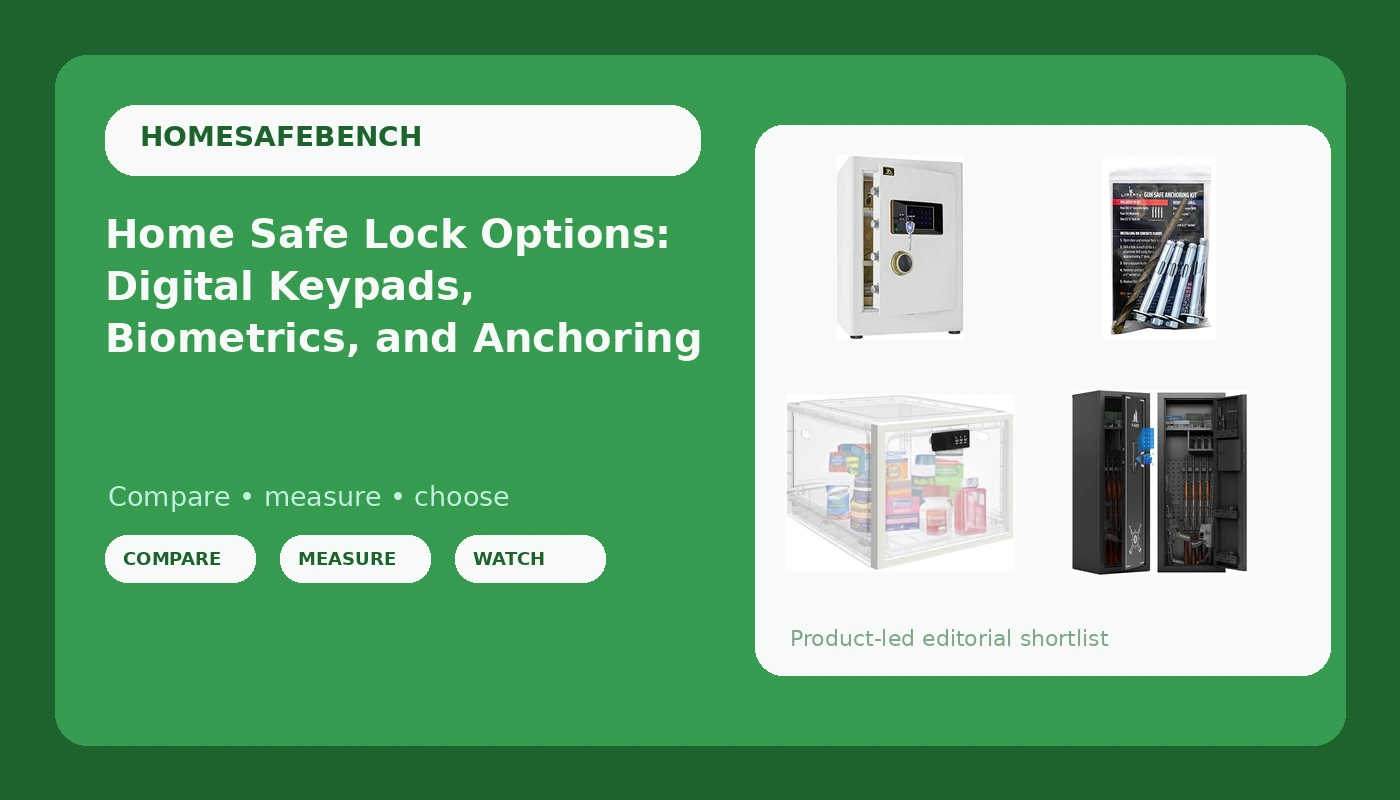
I have opened a lot of home safes for a living, and the thing that decides how long I stand there is almost never the thickness of the steel in the brochure. It is the lock, the gap around the door, and whether the box is bolted to something that does not move. When people ask me about home safe lock options, they usually want a brand name. What they actually need is a short list of questions: who has to get in, how often, what happens when a battery dies, and could one person carry the whole container out of the house. This piece walks through the lock families, the anchoring question, and four products that cover different jobs, from a closet safe for documents to a small combination lock box for medication.
Related: How Fire Ratings Are Actually Measured →
Quick answer
A home safe is three decisions stacked on top of each other: the lock, the container, and the anchor. For documents and everyday valuables kept in a closet, a freestanding home safe with a touchscreen digital lock is the honest middle ground, because you can change the code and you are not depending on a fingerprint sensor. For long guns, a cabinet that offers both a fingerprint reader and a keypad gives you two ways in. If your floor is concrete, an anchoring kit turns a heavy box into a fixed object instead of a heavy box. For medication, a small combination lock box is an access-control tool, not a security container. Buy for the threat you actually face, which for most households is a quick smash and grab, not a crew with tools and time.
Four useful options
| Model | Best fit | What stands out |
|---|---|---|
| TIGERKING Home Safe with Touchscreen Digital Lock, 2.05 Cu Ft | Documents and small valuables in a closet or office | Touchscreen digital lock with 2.05 cubic feet of interior volume |
| KAER Biometric Gun Safe Rifle | Long-gun storage at home | Fingerprint and keypad entry with adjustable racks |
| Liberty Safe Heavy Duty Concrete Gun Safe Anchoring Kit | Fixing a safe to a concrete floor | Heavy duty concrete anchoring hardware |
| Medicine Lock Box for Safe Medication, 10L | Medication, phones, and shared-space storage | Combination code lock with 10 liters of capacity |
Freestanding home safe: TIGERKING Home Safe with Touchscreen Digital Lock
A digital keypad is the lock type I recommend to most households, and I say that as a man who keeps a mechanical dial on his own safe. The trade is simple. A keypad lets you change the code the day a roommate moves out, it lets you hand a temporary code to a contractor, and it does not require you to stand in front of the door spinning a dial in the dark. What it does require is a battery, and batteries fail on their own schedule. Almost every keypad safe has a key override, which is also the weakest point on the whole box, because a bypass is a bypass. Keep the override key somewhere other than the top of the safe. For a container this size, the anchoring question matters more than the lock: a 2.05 cubic foot safe is a two-person carry, and if it is sitting loose on a closet floor, the lock is doing all the work alone.
Long-gun cabinet: KAER Biometric Gun Safe Rifle
I make fun of biometric locks, and I installed one on the shop door anyway, so take that for what it is worth. A fingerprint reader is genuinely fast when your finger is clean and dry, and genuinely useless when it is not. Cold hands, a cut thumb, a little grease from the garage, and you are standing there trying again while the thing beeps at you. That is exactly why having a keypad as the second method on the same cabinet is the sensible design, and it is the reason I would not own a biometric-only container. Keep a code set as a backup even if you enroll your prints. The adjustable racks matter more than people expect, because a cabinet that holds 14 to 15 firearms only does so with the interior laid out for the guns you actually own.
Anchoring hardware: Liberty Safe Heavy Duty Concrete Gun Safe Anchoring Kit
Weight is security, but only until someone shows up with a hand truck and a friend. The single cheapest upgrade to any safe is bolting it down, and it is the step most people skip because it means drilling holes in a floor. A concrete anchoring kit is the right answer when the safe lives in a garage or basement with a slab under it. A few practical notes before you drill. Confirm what is under the concrete, because post-tension slabs and radiant heat tubing do not forgive a masonry bit. Check whether you rent, because a landlord may have opinions about four holes in the floor. And anchor through the bottom or the back into framing if concrete is not available, since a safe attached to a wall stud is harder to tip than a safe attached to nothing.
Access-control box: Medicine Lock Box
I want to be straight about what this category is. A 10 liter combination lock box is a deterrent and an access-control device. It keeps a curious kid out of a medication bottle, it keeps a roommate out of your snacks, and it makes a phone inconvenient to grab during study hours. It is not pry resistant, it is not fire rated, and a determined adult with a screwdriver will get into it. That is fine, as long as you bought it for the right job. Use it where the threat is casual access rather than theft, and do not put anything irreplaceable inside it. The combination lock does mean no key to lose, which is a real advantage for a box that lives in a shared kitchen or a dorm room.
Prices and availability may change. Product images, names, and retailer links are matched to verified listings. No current price, rating, stock status, or measured result is stated here without current evidence.
What the lock actually decides
There are three lock families on consumer safes, and they fail in different ways.
A mechanical dial has no battery, no sensor, and no firmware. It can be opened by manipulation, which is a skill, not a magic trick, and it is slow for both the owner and the thief. If you open it twice a year, a dial is fine. If you open it twice a day, you will learn to hate it.
A digital keypad is fast, changeable, and auditable in the sense that you can hand out a code and take it back. Its weaknesses are the battery, the keypad membrane, and the override key. A keypad that eats batteries in a month is a design problem, not a user problem, and it is worth reading owner comments specifically about battery life before you commit.
A biometric reader is the fastest option when it works and the most frustrating when it does not. Sensor quality varies enormously between units. Enroll more than one finger, enroll them from a few different angles, and always keep a code or a key as a second path.
The lock is the safe. Everything else is a container.
What bolt work and fire ratings actually mean
Pry resistance comes from two things: the gap between the door and the body, and the bolt work behind it. A crowbar needs a lip to bite. A tight door gap gives it nothing to work with, and thick bolts that extend into the frame on the hinge side and the opening side turn a thirty-second pry into a five-minute fight. A thief with a five-minute window usually leaves. That is the whole game, and it is why I care more about door fit than door thickness.
Fire ratings are measured, not imagined. A rating is a number of minutes at a specific external temperature, paired with a limit on how hot the inside of the container is allowed to get. Read the fine print, not the sticker, because a sticker is marketing and a test report is evidence. If a listing claims fire protection without naming the standard or the time and temperature, treat it as a description of the paint.
How to choose, step by step
- Write down what actually goes inside, and be honest about volume. A stack of documents and a hard drive take far less room than a jewelry box collection or a camera kit.
- Decide who needs access and how often. Frequent access points to a keypad. Occasional access can live behind a dial.
- Match the container to the threat. A smash-and-grab burglar and a prepared thief require different answers, and most households face the first one.
- Plan the anchor before you buy, because the floor you have determines whether you need a concrete kit, a wall anchor, or a heavier container.
- Decide what happens when power fails. Every electronic lock needs a backup path, whether that is a code, a key, or a battery terminal you can reach from outside.
Practical guidance before you buy
- Measure the space twice, including the door swing and the clearance you need to open it all the way.
- Weigh the empty container against your floor and your back, then add the contents.
- Check the battery type and how the lock reports a low battery, because a safe you cannot open is a safe you will defeat with a grinder.
- Store the override key or the master code somewhere other than on or near the safe.
- Ask what the fire rating references, and walk away from any listing that will not say.
Which option should you choose?
Choose the TIGERKING Home Safe with Touchscreen Digital Lock, 2.05 Cu Ft when your priority is documents and small valuables in a closet or office and you want a code you can change. Choose the KAER Biometric Gun Safe Rifle,Gun Safes for Rifles and Pistols Holds 14-15 Firearms with Adjustable Racks & Pistol Storage,Fingerprint Keypad Lock Gun Cabinet for Home & Hunting for Enthusiasts when you need long-gun storage with both a fingerprint reader and a keypad, and you want the interior laid out with adjustable racks. Choose the Liberty Safe Heavy Duty Concrete Gun Safe Anchoring Kit when your safe sits on a concrete slab and you are ready to bolt it down, which is the upgrade I would make before buying a more expensive container. Choose the Medicine Lock Box for Safe Medication, 10L Lockable Storage Box for Fridge/Snacks Food, Phone Lock Boxes with Combination Code for Home/Dorms/Office Storage (1, Translucent White) when the problem is casual access to medication, snacks, or phones in a shared space, and you understand that it is a deterrent rather than a vault.
One caveat applies to all four. I have not pry tested or lock tested these specific units, and I am not going to pretend otherwise. What I can tell you is what the lock type, the capacity, and the anchoring method mean in practice, and how to check those things against your own situation before you spend anything.
The bottom line
Buy the lock you will actually use, in the container that fits what you store, and then bolt it to something that does not move. For most households that means a keypad safe for documents, a two-method cabinet for long guns, an anchoring kit if there is concrete under the floor, and a small combination box for the everyday access problem. None of these stops a determined professional, and any product page that says otherwise is selling you a feeling. Match the box to the threat you actually face, anchor it, keep the backup key somewhere else, and change the code when the people with access change.