Most people shop for a safe backwards. They pick a size, they compare prices, and they never ask the two questions that decide the purchase: can a thief find it, and can fire reach it. How to choose a home safe is really about answering those two questions honestly, because the honest answers point at two completely different products.
I have been a locksmith in Boise for 25 years. I have opened bank deposit boxes, hotel units, gun cabinets, and a long list of consumer safes that the owner swore were impenetrable. The failures follow a pattern. The safe that gets beaten is the one bolted to a closet shelf, running a short code, with the backup key taped inside the lid.
There are two approaches that work. Hide the safe inside a wall so a burglar never knows it exists, or buy enough steel and enough rated fire protection that hiding it stops mattering. The Grimtron hidden wall safe and the 6.0 cubic foot freestanding cabinet sit at the head of those two paths, and the rest of this article is the checklist I use to decide which path a household belongs on.
Why you should trust me
I have spent 25 years with a pick set, a scope, and a 24-inch crowbar in the same bag. My workshop notebook has a page for every lock family I have worked on, and the entries are not kind. Most consumer safes fail at the same place, and it is almost never the steel thickness on the marketing sheet.
Every safe that comes through my shop gets the same treatment: a pry session on the door gap, a look at the bolt work behind the door, and a manipulation session on the lock. That is how I learned that a tight door gap with two well-placed bolts beats a thick door with a sloppy frame, and it is why I stopped caring about brochure weight numbers.
I do not sell safes. I open them, I install them, and I tell people when the thing they bought is a steel box with a suggestion attached. What I care about is whether a safe survives the ten minutes a real burglar is willing to spend, and whether the documents inside survive a house fire.
How I picked and how I tested
I run the same checklist on every unit: what the lock is, how the door gap looks, how the bolts engage, what the fire rating paperwork actually says, and how the thing mounts to the structure. Two safes made this list because they answer the two main household threats cleanly, not because they share a price bracket or a size.
For a hidden wall unit, the questions are about the cavity. Stud spacing has to match, the wall has to be deep enough, and the installation has to be reversible enough that you are not rebuilding drywall in a rental. For a freestanding cabinet, the questions are about anchoring, doorway clearance, and whether the fire and water claims hold up on paper rather than on a sticker.
Where I cannot verify something from the outside, I say so. I am not going to quote a bolt count for a safe I have not opened, and you should not trust a listing that quotes one without showing you the door. What I can tell you is what each product promises, what that promise means in a real house, and what to check the day the box arrives.
The two safes that fit this job
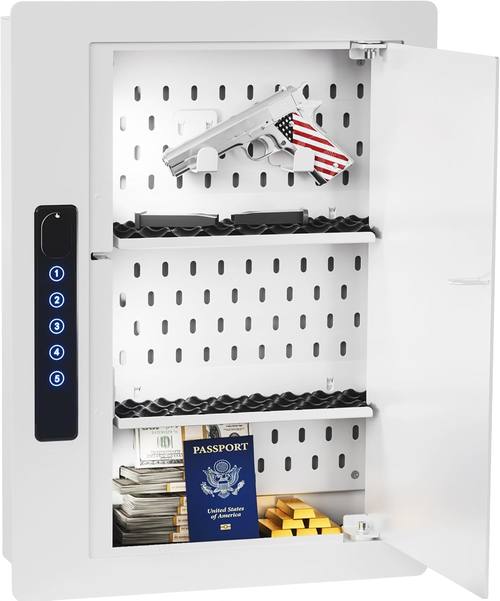
Hidden wall pick: Grimtron Hidden Wall Safe Between 16" Studs, Electronic Keypad, White
 Visit on Amazon →
Check current Amazon price, then measure your wall before you order, because 16 inches on center is the standard for residential framing but not a guarantee in an older house.
The appeal here is the word hidden. A wall safe between studs disappears behind a hinged picture, a mirror, or a panel in the closet, and a burglar working a 10-minute window does not tear out drywall on a hunch. That single fact does more for your security than another hundred pounds of steel sitting in plain sight on the bedroom floor.
The electronic keypad is the honest middle ground in my book. It is fast, it does not care that your hands are full, and it does not lock you out after three tries the way some fingerprint units do. The trade-off is the one every digital lock carries: batteries. Put a reminder in your phone for a yearly battery change, and keep the spares in the kitchen drawer, not inside the safe.
Flaws but not dealbreakers: A wall safe is small by definition. It holds documents, passports, a few pieces of jewelry, and a modest amount of cash. It will not hold a laptop plus a shoebox of paperwork plus your grandmother's silver. The white finish also shows scuffs if it ends up in a high-traffic hallway.
Renters and anyone in a house with standard 16-inch framing who wants a safe nobody can see should start here.
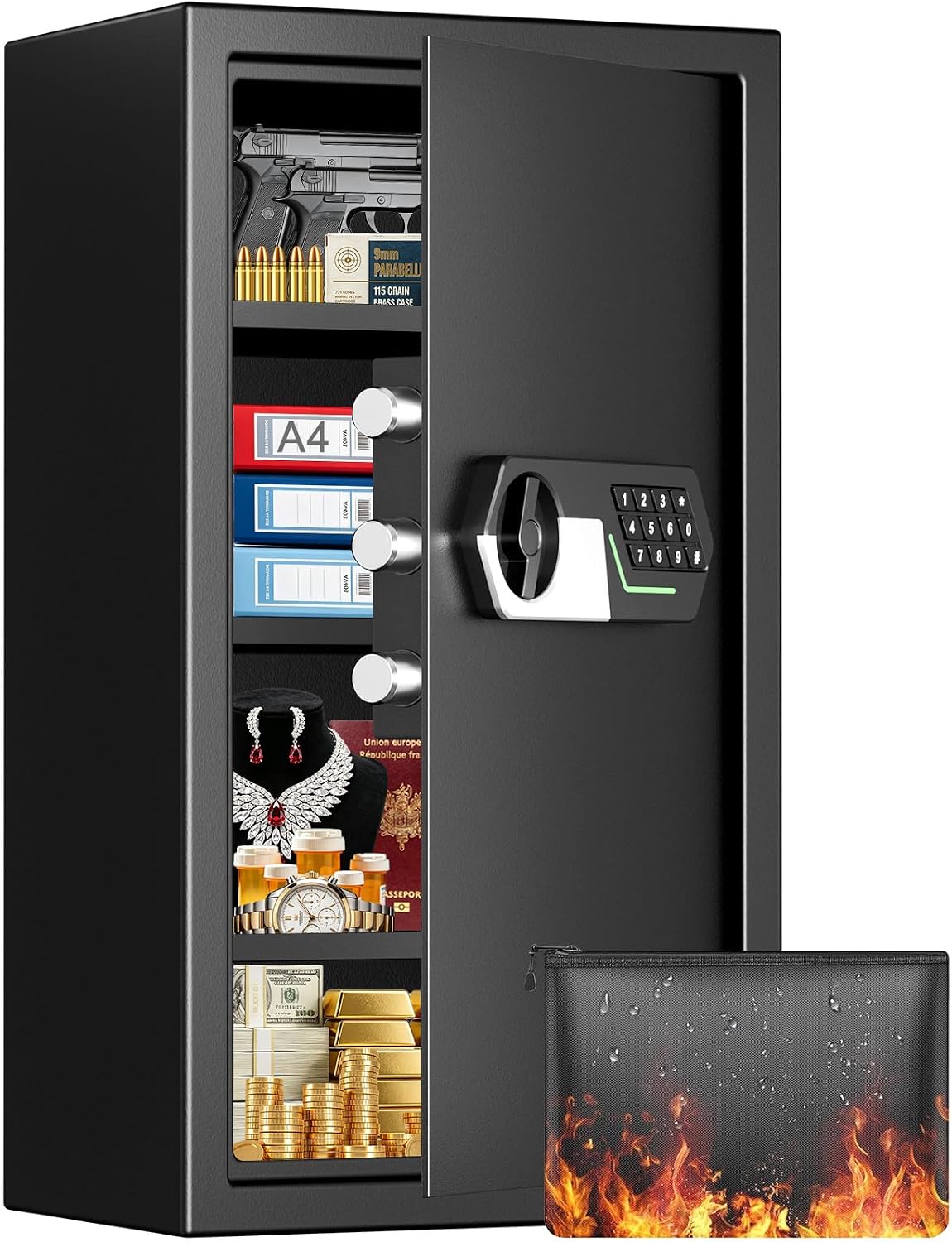
Freestanding pick: 6.0 Cuft Large Home Safes Fireproof Waterproof, Anti-theft Fireproof Safe Box with Keypad Key and 3 Removable Shelves, Digital Security Safe Water and Fireproof, Document Safe for Home Money Valuables
 Visit on Amazon →
Check current Amazon price before you commit, because a cabinet this size is a purchase you want to make once.
This is the other path. Six cubic feet is a real cabinet: three removable shelves, a keypad plus a key backup, and fire and water claims written into the product name. When you cannot hide a safe, you buy volume, weight, and a rating, and you anchor it so a thief has to work in the open with the clock running.
Two caveats before you order. First, fireproof and waterproof are claims that deserve a fine print read. A fire rating means minutes at a specific temperature, and a waterproof claim means a seal survived a specific test. Ask what the rating covers and for how long, because the difference between 30 minutes and an hour is the difference between a fire truck arriving and a pile of ash. Second, measure every doorway between the delivery truck and the final spot. A cabinet this size is not something you want to move twice, and you will not get it around a tight landing.
Flaws but not dealbreakers: The keypad plus key combination is the right call for redundancy, but the key becomes a liability the moment you leave it in the lock. A cabinet this size also invites you to store things you cannot replace next to things you can. Keep the irreplaceable items on the top shelf, where water damage reaches last.
Families with a stack of documents, a few valuables, and no good hiding spot should look here first.
The actual workflow
Step one: name the threat. Most households face a smash-and-grab burglar with a bag and about ten minutes. A few face fire, flood, or a targeted thief who already knows what you own. Write down which one you actually face, because the answer changes everything downstream.
Step two: choose hidden or visible. If you have standard stud framing and a wall nobody stares at, go hidden. If your walls are plaster, brick, or full of plumbing, go freestanding and anchor it. Do not buy a freestanding safe and hope nobody notices it in the bedroom closet. They notice.
Step three: measure before you buy. For the wall unit, confirm stud spacing at 16 inches on center, confirm the cavity depth, and confirm the height you can live with once it is in. For the cabinet, measure the doorways, the stairwell turn, and the floor space with the door swung open, not just closed.
Step four: anchor it. A wall safe gets screwed into the studs on both sides. A freestanding cabinet gets bolted to the floor or into wall studs with hardware rated for the job. An unbolted cabinet is a two-person carry for a thief and a permanent shoulder injury for you when it tips forward.
Step five: set the code and handle the backup key. Change the factory code the day it arrives. Do not use your birthday, your address, or the last four digits of anything. The backup key goes to a safe deposit box, a trusted relative, or a locked drawer in a different building. Not taped to the safe, not in the same room.
Step six: read the fire rating fine print. Paper chars at a lower temperature than most people assume, and digital media fails even sooner. Know what your rating covers, and know what it does not.
Step seven: load it with a plan. Irreplaceable documents first, then valuables, then everything else. Photograph what you store and keep that record somewhere other than the safe.
Step eight: test it once a year. Open it with the code, open it with the backup key, and check the batteries. A safe you cannot open is a very heavy filing cabinet.
What I left off the list and why
I did not include a biometric-only box. Fingerprint readers are fast, and I installed one in my own shop, but a battery is a single point of failure and a cold or wet finger is a bad credential. A keypad with a key backup is the more honest design for a household.
I also left off the lightweight portable boxes, the ones that weigh about as much as a case of soda. Weight is security. Anything one person can carry out under an arm is not a safe, it is a lockable lunch box, and the fire rating on those units tends to be a sticker rather than a test result.
And I skipped the chests that advertise fire protection without a rating behind it. If a listing will not tell you the minutes and the temperature, you are buying a plastic liner and a promise.
What this actually costs
The hidden wall unit sits at the lower end of the two, and the freestanding cabinet costs more because there is more steel, more volume, and more rating inside it. Check current Amazon price on both before you decide, since both move with sales.
Installation is where people get surprised. A wall safe is a weekend project with a stud finder and a drywall saw if you are comfortable patching drywall, and a two-hour job for a handyman if you are not. A freestanding cabinet needs a floor anchor or a wall anchor, a hammer drill, and a second person to lift it.
The real cost is the thing you are protecting. If the contents are replaceable with a phone call to the insurance company, buy the smaller unit and stop worrying about it. If the contents are a passport, a deed, a birth certificate, or a set of photos that exist in exactly one place, spend the money on the cabinet and bolt it down.
That is the whole decision. Hide it or rate it, then anchor it, then change the code. Everything else is marketing.